”At Essetre, we are sustainable, just like the material we work with.”
From sustainability to innovation, from new technologies to investments and the renewed relationship with Weinig: Cristina Sella, Managing Director of Essetre, told us about the latest developments and the future vision of the Italian company.
There is a thread that runs through the present and reaches toward the future. A thread made of choices, some small and invisible, others capable of changing the way we will live tomorrow. Today, talking about sustainability – especially for companies – means talking about responsibility, about a concrete way of being in the world, as individuals and as businesses, in a context where every decision weighs on industrial performance, but also on people’s well-being and on the legacy we will leave to future generations.
In the manufacturing world, this awareness has become a true driver of change. The energy transition, the reduction of emissions, the smarter use of resources, respect for the local area, but also attention to workers’ quality of life: sustainability is no longer just a label, but an approach that takes shape in many different ways.
And it is in this scenario that Essetre, an Italian company specializing in the design and production of CNC machining centres for the wood sector, comes into play. Its machines are used all over the world to process beams, panels and structural components. For years, the company has been pursuing a path that combines vision and pragmatism, a commitment born both from an ethical sense and from the need to respond to increasingly complex customers, markets and production processes. It is a change that, as Cristina Sella, Managing Director of the Veneto-based company, explains, has required time, courage and the willingness to improve every single aspect. From certifications to new solutions that reduce energy impact, from ethical and social choices within the company to a new “paradigmatic” showroom, made of wood and able to showcase the many steps forward made by the company.
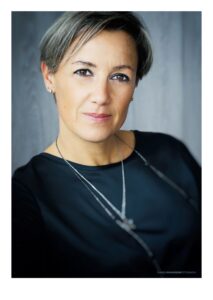
Cristina Sella
“For us, sustainability is not just a set of procedures or certifications,” explains Cristina Sella. “It is a daily commitment to using resources better, to giving back to the local area what it offers us and to growing the company without leaving any debris behind, neither environmental nor social. It is a balance between what is right to do and what is necessary to remain competitive. And when we talk about concreteness, it is inevitable to also rely on tools such as certifications, which force you to look inside yourself and make measurable what previously was only good will.”
“This year,” she continues, “we obtained ISO 14001 environmental certification. It was a journey of about a year and a half of work, because certification ‘forces’ you to put things in order everywhere: procedures, controls, documentation. Many things we were already doing, such as the management of fumes, discharges and waste, and ISO allowed us to structure and optimise what was already in place.
From a practical point of view, we carried out in-depth analyses on the impact of paints, which are now water-based, improved management and introduced several important investments: we are installing the second batch of solar panels, we have replaced all the heat pumps and we are about to integrate a new machining centre. These are measures that improve efficiency, reduce consumption and emissions and allow us to move in a more responsible direction.
For us, sustainability is made of concrete choices, not slogans. It is process optimisation, waste reduction, and attention to people and the local area.”
How do you integrate sustainability into your supply chain and your technologies?
“We have an almost entirely local supply chain: suppliers from the area, less transport, fewer emissions and a very direct relationship with those who work with us. It is an environmental advantage, but also a social and territorial one.
On the technological side, we have been focusing for years on procedures for energy recovery and waste reduction. Our dual-spindle heads, to give a very concrete example, reduce tool change times and therefore overall consumption, while the software on our machines simulates the work before starting, so waste, time and material scraps are reduced. Wood – and we never tire of repeating it – is already a sustainable material in itself, since waste does not end up in landfill but always finds a reuse, even the simplest one.
Our idea of sustainability is precisely this: constantly striving to improve processes, reduce waste, innovate technologies and give back value to the local area where we operate. It is not just an environmental issue, it is a way of being a company.”
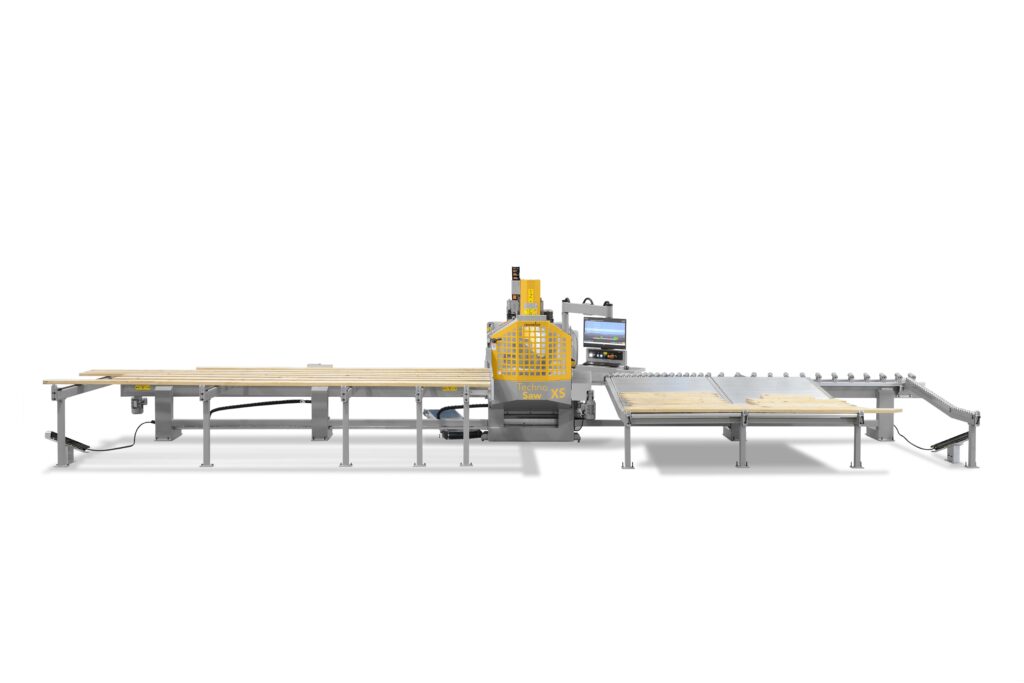
“Techno Saw XS”.
Among the “hot” topics this year there has also been the 5.0 transition…
“Definitely a hot and also complex topic. The measures for Industry 5.0 have been much more complicated than those for 4.0. We have studied, attended conferences, sent both the sales team and the administration for training, but it is an objectively complex system for those who try to manage it on their own.
We have nonetheless managed to help several customers take advantage of it to purchase our machines and we have also applied it internally, linking it to a package of investments: the new machining centre, photovoltaic panels, and the complete replacement of the heat pump system. All of this was made possible thanks to an internal team and an external consultancy firm that supported us.”
Among the new developments in 2025 there is also the new showroom…
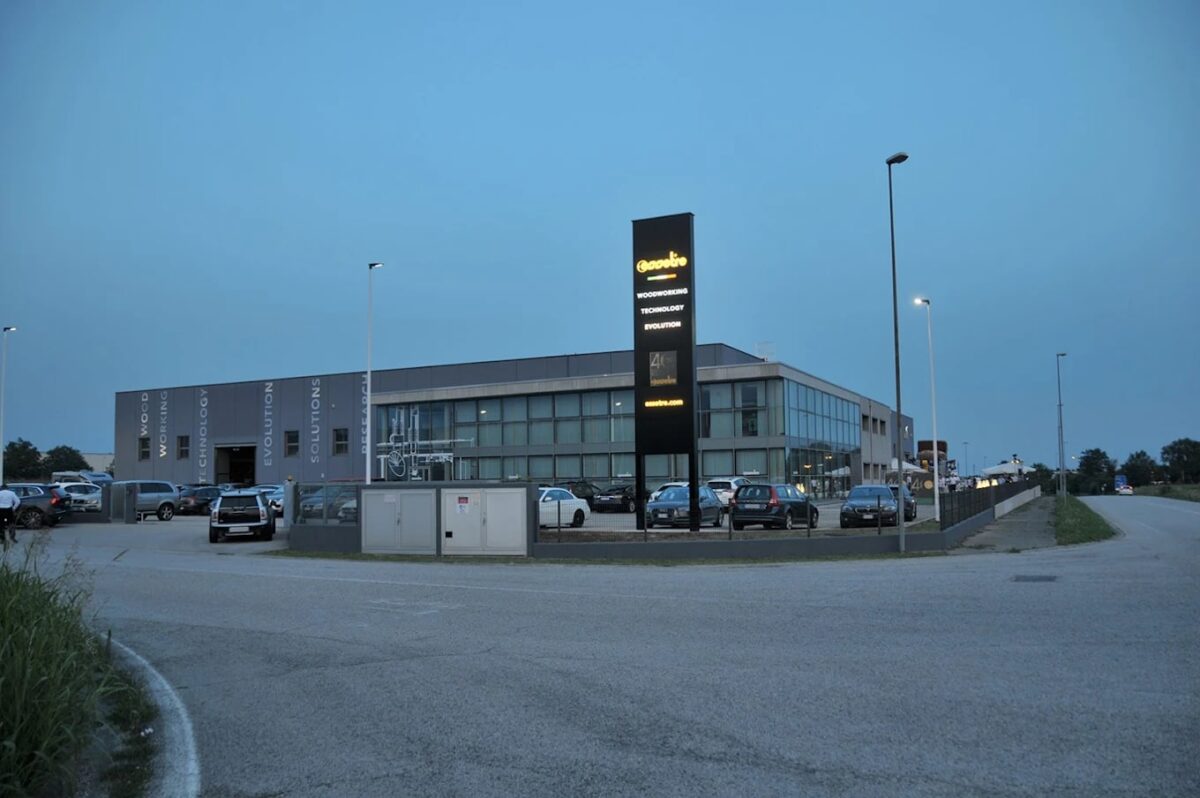
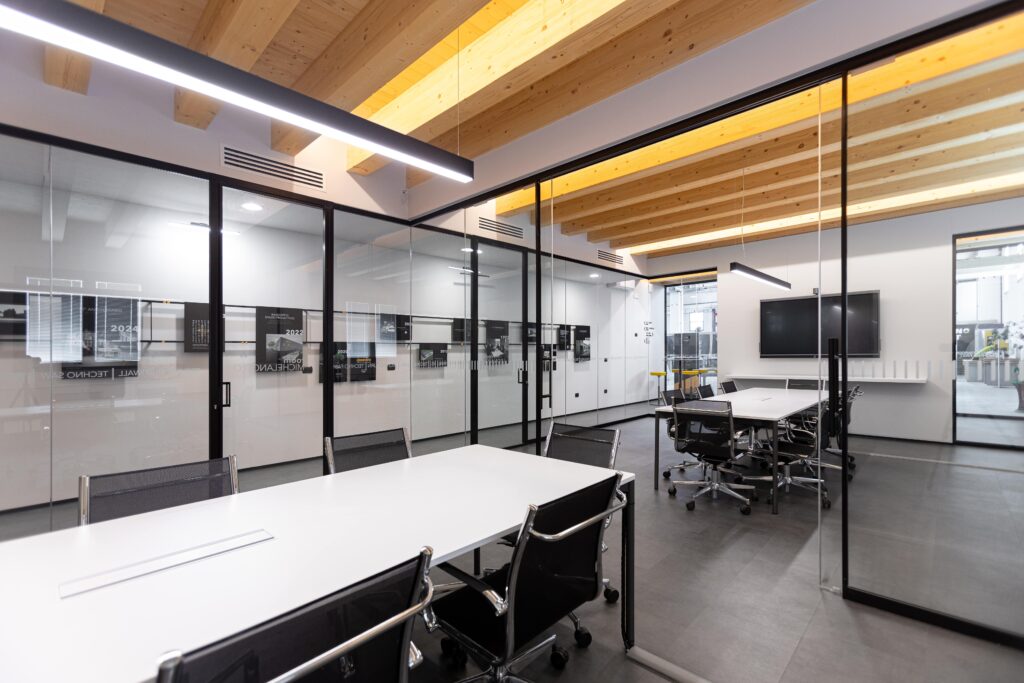
“Exactly, our new showroom is finally ready. We have been working on it for years, because initially it was not perceived as a priority. In reality, a space dedicated to customers was really missing: we doubled our production area, but production and hospitality are two different worlds. During one of the latest open houses, this became very evident: bringing together moving forklifts, active machining and visitors is not easy, not even from a safety point of view.
The showroom has changed everything. Today we have dedicated offices for customers, a coffee area and a separate entrance completely detached from production. Inside there are three machines that are always operational, rotating depending on the batches, and which we use for demos, tests and final checks. Customers bring their own beams and we work together in real time.
This, in addition to improving the visit experience, allows us to protect the confidentiality of proprietary solutions and has truly been a turning point, also from a cultural perspective. It is a more ‘organised’ approach that allows us to give visibility to customers without interfering with production.
And there is also a natural connection with sustainability. The structure of the showroom is entirely made of wood, built by one of our customers using our Essetre machines. The soul of the building is wood processed by us, a signal consistent with the company’s values and, in a sense, a permanent ‘test bench’ (she smiles, ed.) for our technologies.”
Not only the showroom: what are the latest technological innovations you have introduced?
“In recent months we have introduced several new developments. One of the most interesting is definitely a new application developed from the base of our “Techno Multiwall”, which we presented at Ligna. It is a solution that is attracting a lot of interest because it completely changes the approach to panel processing.
Instead of rotating the wall to work on both sides – explains Cristina Sella – it is the machine head that moves around the piece. The panel remains completely still, thanks to a structural riser that we specifically designed for this purpose. The savings are enormous, in terms of both time and energy.
We are not talking about flipping a small beam. Here we are talking about a house wall, a heavy element that requires pistons, force and significant movements. Eliminating that process means reducing consumption, complexity and risks, and achieving a much smoother work cycle. Often this energy aspect is not even mentioned, yet it really makes a difference.
The other new development is a machine for packaging, the “Techno Saw XS”. We started from an existing technology, made it lighter and adapted it to the needs of a sector that requires speed, simplicity and clean cutting.
The American market, in particular, is asking for it a lot: they often work on smaller cross-sections and need extremely fast machines. The “Techno Saw XS” is more compact, more compact, faster and optimised for these contexts, but without sacrificing Essetre quality: the electrospindles are the same, the structure is the same. It is ‘entry-level’ only in terms of its position in the range, not in terms of quality.”
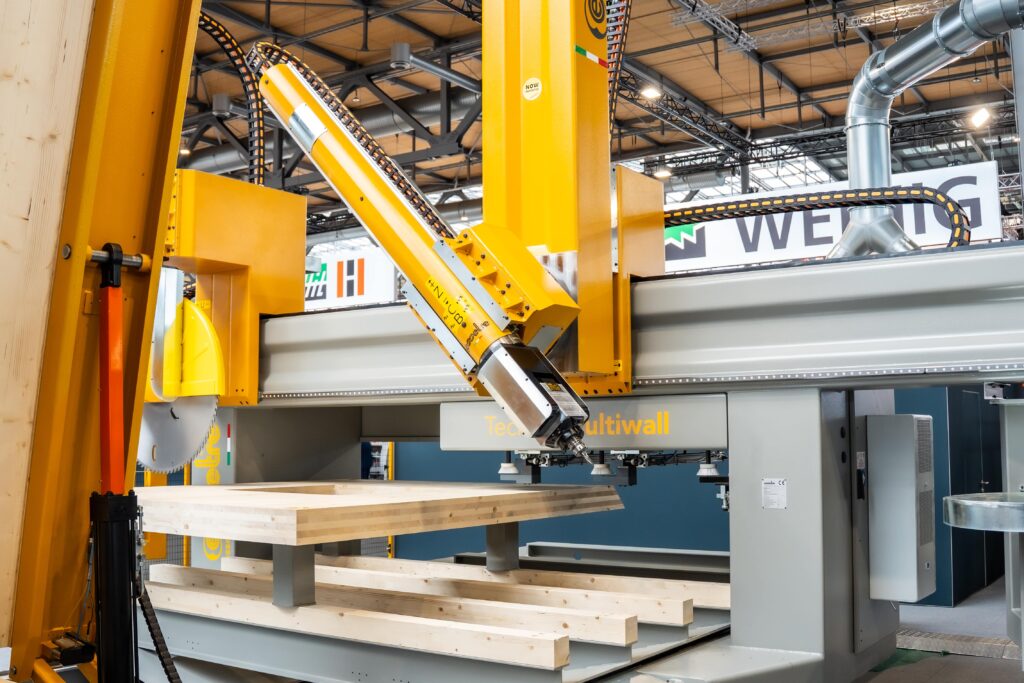
“Techno Multiwall”.
How did the end of 2024 and 2025 go?
“2025 went well, in line with expectations. At the end of 2024 we were facing two possible scenarios, given the general uncertainty between the political context and wars: we managed to achieve the more optimistic one and reached our goals. The real unknown now is 2026, which looks more complex. Despite this, our sales team is very active, the collaboration with Weinig is bringing concrete results and we are working to maintain our presence in as many markets as possible.”
How did the collaboration with Weinig start and how is it developing today?
“The relationship with Weinig has its roots in the past. There was a first contact several years ago, but at that time the proposal that was made was not in line with our strategic needs. With the arrival of Gregor Baumbusch, a technically very knowledgeable figure with a strong understanding of the sector, the dialogue reopened: he immediately understood the value of our solutions and a natural alignment was created on the technological and production level.
With Weinig, we share a similar approach to machine design, construction and component selection. They prefer German suppliers, we prefer Italian ones, but the philosophy of quality is the same and neither side uses cheap or compromised solutions. This creates the basis for a very solid technical collaboration: we often compare notes on design issues, exchange ideas, diagrams and solutions. It is a constant and mutual dialogue.
From an organisational point of view, we have maintained full autonomy. The company continues to be family-run and, internally, there have been no changes in operational management. The relationship with the German side is frequent and structured, especially on the marketing front: we collaborate on various projects while each side maintains control over its respective markets and product lines.
It is a balanced partnership, based on respect, complementarity and continuous exchange. Even any commercial overlaps are managed with transparency and professionalism.
Our future – concludes Cristina Sella – I see as a continuous upward climb: nothing is taken for granted, but it is full of new challenges. And that is fine by us, because it is in the constant search for new stimuli that Essetre has always been able to reinvent itself.”
Read also...
Mmfa: a 2025 exceeding 100 million square metres
The new “Wallteq M-300” by Weinmann
Altendorf introduces new F 30 sliding table saw for the craft segment
“Ecobox” and “Osb Flammex”: Egger’s new solutions
Over 300 attendees in Lazise: Holzbau Forum Italia and the future of timber construction