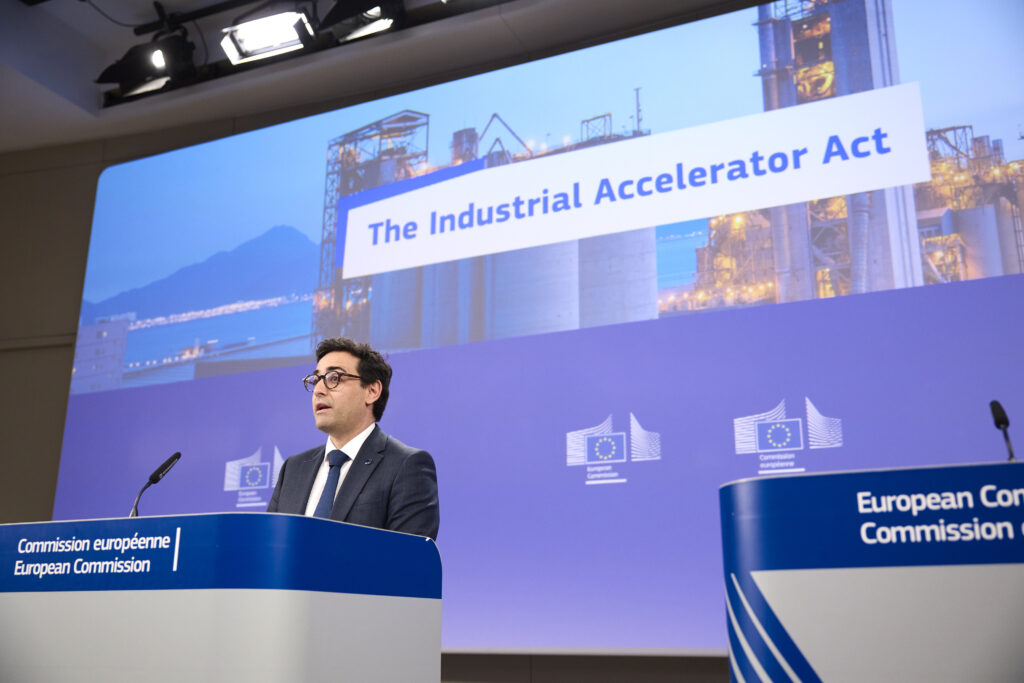
Positive signals for Europe are emerging from industry at a time when the geopolitical and economic context remains far from simple. Amid trade tensions, slowing global demand and increasing competition with the United States and China, the European Commission has presented the Industrial Accelerator Act, a policy initiative aimed at strengthening Europe’s manufacturing base and increasing the sector’s contribution to 20 percent of EU GDP by 2035.
The proposal forms part of a broader strategy to reinforce the continent’s industrial competitiveness. It includes measures designed to support manufacturing investments, simplify regulatory procedures and introduce criteria favouring European production in public procurement. The overall goal is to reinforce domestic production capacity and reduce strategic dependencies within global value chains.
While the initiative focuses primarily on sectors considered critical for the industrial and energy transition—such as steel, aluminium, batteries and energy technologies—it reflects a wider effort to reposition manufacturing at the centre of Europe’s economic strategy.
For the wood and furniture supply chain, the impact is likely to be indirect but nonetheless relevant. As part of the wider European manufacturing ecosystem, the sector shares many of the challenges addressed by the new strategy, including competitiveness, technological innovation and supply-chain resilience. Policies aimed at strengthening industrial production in Europe may therefore create broader opportunities across related value chains, including wood processing technologies and furniture manufacturing.
In addition, the growing emphasis on sustainable materials and low-carbon production could further enhance the role of renewable resources such as wood within Europe’s industrial and construction strategies. In this sense, the Industrial Accelerator Act is less about immediate sectoral effects and more about a broader signal: the return of manufacturing as a central pillar of Europe’s economic policy.