A thousand uses of wood: the Stranger Things case
We waited for it, longed for it, searched for it. Between alleged leaks, dreaded spoilers, and theories more or less plausible. And in the end, it arrived: Stranger Things 5 has been released on Netflix. And we devoured it in just a few hours.
A few hours that once again immersed us in the atmospheres of the ’80s, settings and details that turned the series into a global phenomenon.
But beyond the narrative elements and the sci-fi imagery lies a silent protagonist that supports the production’s visual identity (and pushed us to treat this topic on Xylon, editor’s note): wood. From suburban American home furnishings to workbenches, all the way to the material details of the sets, wood becomes the medium through which an era is rebuilt and the credibility of environments defined.
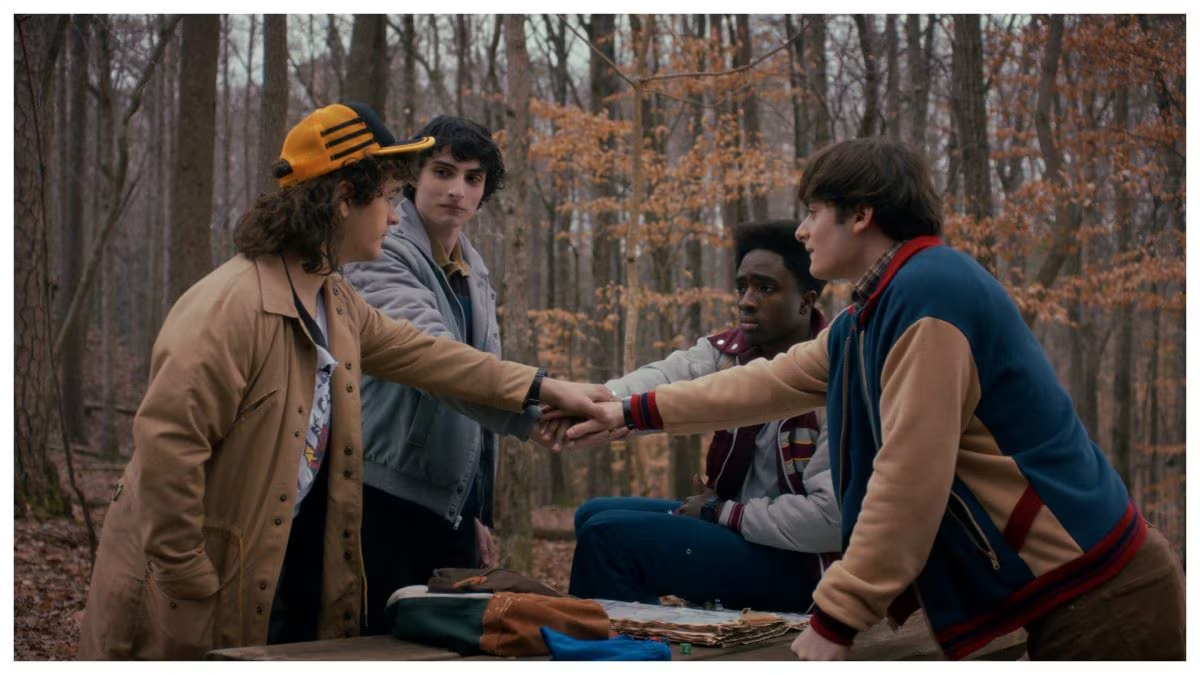
And for industry “insiders” – from technology manufacturers to designers – Stranger Things shows how materials, finishes, and styles can contribute decisively to storytelling, and how design choices related to wood can evoke culture, memory, and authenticity. Objects and environments in which wood becomes the true protagonist, from the Dungeons & Dragons table of the main characters to the most iconic architectures of the series.
WOOD IN THE USA OF THE ’80S
Recreating ’80s America inevitably means confronting a period in which wood was still the absolute protagonist of homes and architecture. Before the massive spread of “advanced” laminates, domestic spaces were dominated by inexpensive solid woods, walnut or oak veneers, and exposed paneling. The most common species—pine, oak, walnut—responded to needs of availability, cost, and workability that reflected a historical moment in which technologies had not yet reached today’s standards, a time when CNCs had not yet replaced manual control, years when full automation was still a mirage.
And in Stranger Things this aesthetic heritage becomes a project: the sets adopt amber finishes, dark boiserie, molded frames, and open-pore surfaces that faithfully recreate the material language of the era. Wood thus becomes a temporal lens, capable of instantly giving viewers the feeling of being in 1980s American suburbia, with each finish carrying its own technical culture.
THE ENVIRONMENTS IN STRANGER THINGS
A technical culture also found in the protagonists’ homes. Rooms, houses, and spaces that reflect very different social and aesthetic segments, in which wood becomes the material that describes them with the greatest precision.
The Byers’ house, for example, is built (or at least appears to be) around inexpensive pine, time-worn surfaces, and dark paneling, creating a lived-in, almost improvised environment that immediately evokes the dimension of an American working-class family. Very different, however, is the Wheeler home, where wood becomes a symbol of the American middle class, the one that in the ’80s invested to give the home a more formal and “complete” appearance, and thus engineered walnut veneers, more refined finishes, and shaped frames seem to appear.
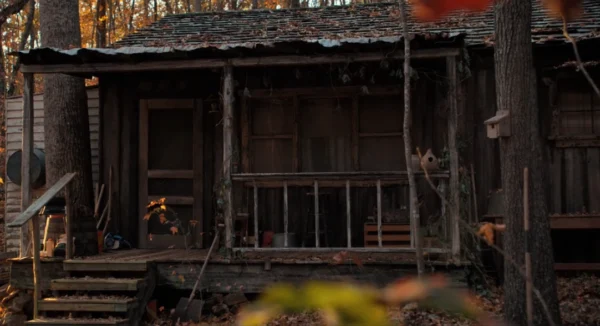
Last but not least, at the opposite extreme from the Wheeler house, we find Hopper’s “cabin,” where Eleven takes refuge at the beginning of season two: a decidedly more rustic structure, typical of the Midwest woods, with squared logs, massive flooring, and essential furnishings built with far less refined but truly “zero-kilometer” materials. It is an architecture that speaks of self-sufficiency, isolation, and practicality, using wood in its most direct and functional form.
Not only that, transitional spaces too, such as basements, boathouses, or Will’s shack, follow this logic: raw woods, essential structures, unfinished surfaces, recreating places where material shows its most authentic nature, with knots, irregularities, and variations that reveal an immediate relationship with the surrounding territory.
DIY: BETWEEN CULTURE AND CHAINSAWS
Domestic environments, but not only. The series devotes ample space to the real DIY culture, and consequently to home workshops typical of American suburbia (and of any idea we have of it). Garages and basements show workbenches made from rough boards, simple shelving, hand tools, and old but sturdy machinery. It’s a context that speaks more than the script itself, revealing a DIY culture rooted in territories where wood is part of both the environment and everyday life.
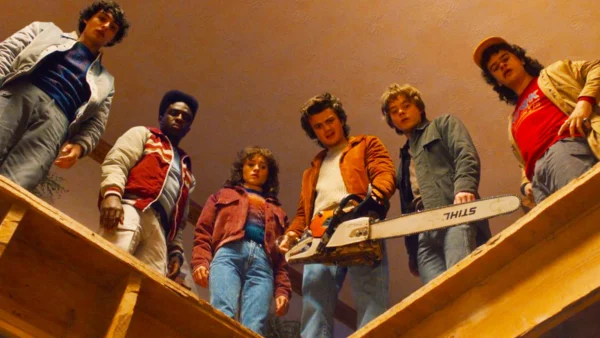
And in this setting we find an object that has become iconic thanks to the series and modern cinema: the chainsaw wielded by Steve Harrington. On the one hand, it consciously recalls ’80s horror cinema, from The Evil Dead to The Texas Chainsaw Massacre, on the other, it is perfectly coherent with a region surrounded by forests, where cutting, repairing, and transforming wood is common practice and often becomes a family activity, passed down in the classic “from father to son” fashion.
Steve’s gesture – that resorting to a household tool – is therefore not just “pop citation,” but the manifestation of a direct relationship with a living material, one that American suburbia has daily experience with. And Stranger Things depicts it naturally, without mythologizing or trivializing it.
OBJECTS AND… THE UPSIDE DOWN
Homes, books, cars, and – without newspaper sheets – objects. What would the series be without references to iconic ’80s games and objects? On one side, arcade cabinets and emerging gaming halls that became new gathering hubs for younger generations; on the other, role-playing games that showcased authors’ imagination and pushed toward new “sceneries,” such as fantasy. And what object is more iconic than the Dungeons & Dragons table around which the kids gather?
It’s a simple table, probably built from an inexpensive wood species like pine or oak, with assembled planks and turned legs: a typology perfectly compatible with a domestic workshop in the 1980s. The slightly worn finish, visible joints, and variations on the tabletop reveal very deliberate scenic choices: it is not a generic object, but a “lived-in” piece, believable in a suburban basement where wood maintains its natural role as a warm, resilient, everyday surface. The scene works precisely because of this, because that table, despite its simplicity, conveys authenticity and becomes a small narrative node made of matter.
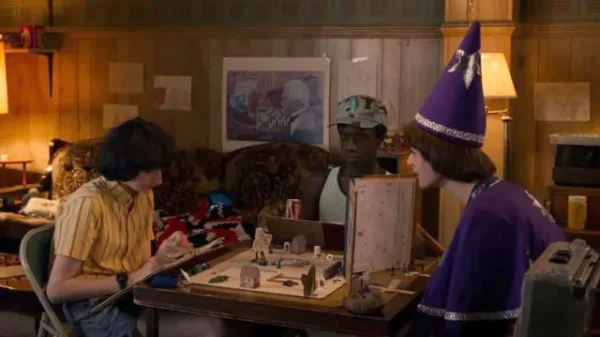
We’ve called the table iconic, but we cannot ignore “the elephant in the room”. The Upside Down calls to us, asks to be analyzed, draws us in. And the wood itself in the Upside Down changes face, losing all reference to its original stability and becoming something deformed, invaded, altered. Beams, panels, and doors appear with exposed fibers, degraded surfaces, and cold color tones. Many of these scenic elements are not real wood, but start from lightweight bases – panels or thin boards – then evidently treated with resins, latex, and pigments to imitate organic deterioration. The most noticeable deformations, such as enlarged knots, collapsed surfaces, or root-like forms, come from deep incisions and manual sculpting, where knowledge of wood’s natural reactions is reinterpreted in a disturbing key to create that dystopian world portrayed so convincingly that it makes us feel the protagonists’ dread.
In the transition from the real world to the Upside Down, wood therefore overturns its meaning: from a familiar, reliable material to a signal of disturbance. It is a strong narrative choice that shows how the same “material grammar” can tell two opposing realities simply by changing workmanship, treatments, and textures.
SURFACE FINISHING
And our journey could only end with the final phase (chronologically, not in importance): finishing. To restore authenticity to the “real” environments, the Stranger Things sets rely especially on surface work, with coating cycles designed to replicate the aesthetics of the ’70s and ’80s. The scenography often uses distressing techniques, combining targeted abrasions and color layering to achieve worn yet believable surfaces. Greyed coatings, multi-layered patinas, and simulated oxidation or fading recreate the effect of years of use, light exposure, humidity, and irregular maintenance. These treatments closely echo woodworking practices of the time, when less uniform products, slower drying, and artisanal application cycles resulted in a visual outcome less perfect but much more characteristic.
When the production instead requires lightness, safety, or the ability to intervene quickly between scenes, wood is replaced by scenic materials sculpted or milled to imitate grains and knots, polyurethane, high-density foams, plastic panels, onto which complex coating cycles are applied, capable of reproducing the optical depth of real wood. In these cases as well, realism depends not so much on the raw material but on the skill with which transparency, satin effects, pigments, and opacity are modulated.
And the final result is born from hybridization—from the choice to rely on wood, but with a “multi-material” approach, a word very familiar to our technology manufacturers. The knowledge of how real wood reacts to coatings therefore allows it to be faithfully replicated, but also to be “betrayed” when storytelling requires it, as in the Upside Down. Here, the same techniques are pushed to the extreme, turning finishing into a visual language capable of suggesting deterioration, alteration, and disturbance.
Wood, therefore, is never just wood. Not even in a TV series. It is the story of everyday life, an era, a way of living and imagining the future. It is matter that speaks, transforms, and allows the story to transform with it. And – to quote Nancy Wheeler – “… the truth lies in the details”.
From screenplay to surfaces, from narrative choices to finishes: it is precisely in the details that Stranger Things finds its credibility. And that wood, once again, becomes protagonist.
Read also...
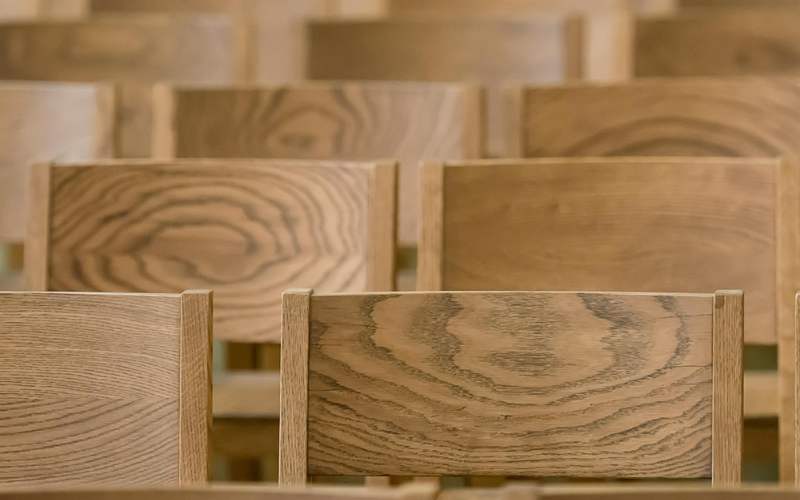
Wood drying: technology, energy and skills at the centre of the debate
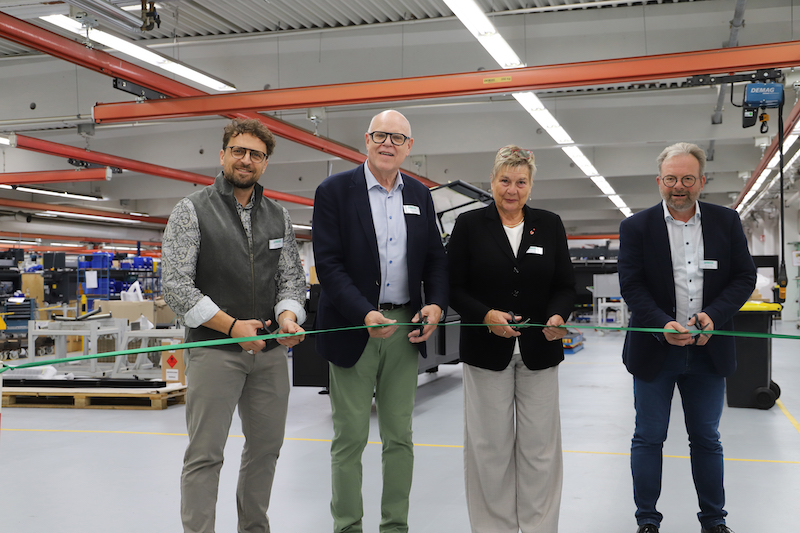
Altendorf concentrates production in Minden

Dürr, new metering pump for industrial coating applications
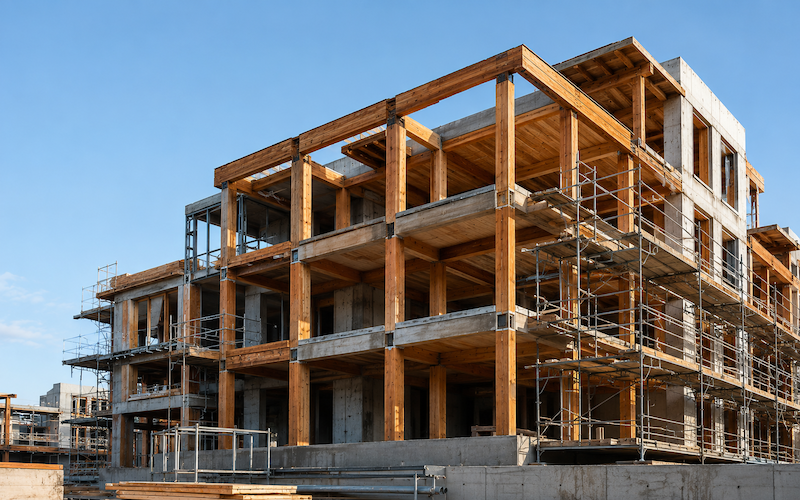
Energy renovation: a challenge involving the wood industry as well
Raute, EUR 31 million order to expand plywood production in Estonia