Cecchini Italia partners with Biesse: design, sustainability and innovation
A modular production model, sustainable materials and a highly interconnected Biesse system are redefining the industrial identity of Cecchini Italia.
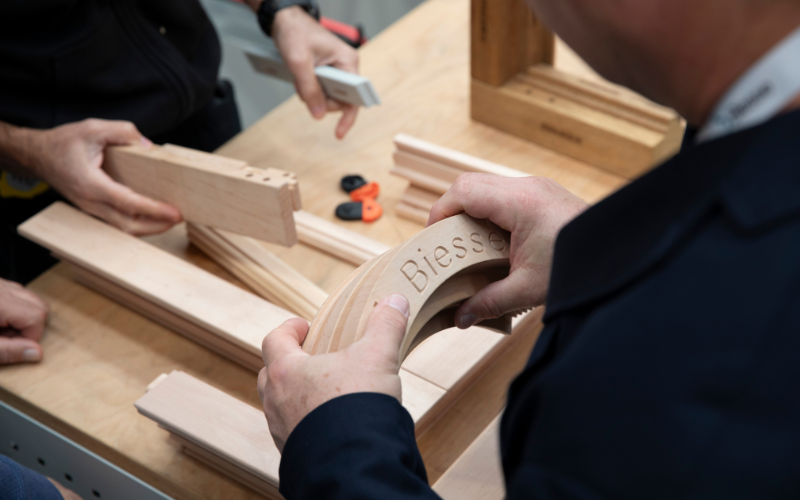
Sustainability, design and innovation guide the evolution of Cecchini Italia, a company founded in 2006 as a small trading business and today a structured player in the furniture sector, thanks to a solid and continuously expanding distribution network. Specializing in classic and contemporary furnishing solutions, the company has built its identity on its ability to offer customized products and attentive service, from the first contact through after-sales support. Along this growth path, Cecchini Italia chose Biesse – the Pesaro-based giant of wood and multi-material processing technologies – to enhance its production processes and strengthen its market positioning.
“Our story began in 2006,” says Diego Cecchini, company owner. “We started by offering the market three locked-in classic-style bedroom sets: an almost mandatory choice, because at the time we did not yet have the necessary structure to manage modularity. In this sense, classic style was the most suitable solution to propose a functional and standardized product within a production context that was not yet oriented toward modularity.
Over time we evolved and gradually directed our strategy toward what was our real goal from the start: to develop a modern, highly modular range with significant depth of assortment, while maintaining an accessible price positioning.”
A key element of Cecchini Italia’s growth has been its collaboration with Biesse, a fundamental partner for the company, which over the years has continued to invest in technology and sustainability. “With Biesse – Cecchini emphasized – we found not only high-quality machines and software, but also constant support that allowed us to look to the future. Thanks to the flexibility of their solutions, we can manage customized production efficiently without compromising quality.”
Over the years, this vision has been refined, aligning the strategy with what had always been the primary objective: developing a modern, highly modular product line characterized by a deep range, while never losing sight of accessible market positioning. At the foundation of the business model, three key drivers emerge: design, sustainability and modularity. Design is handled with rigorous planning and stylistic coherence, with the aim of communicating a clear and recognizable identity. “We do not simply follow trends: we build a uniform aesthetic language capable of speaking to the retailer and, by reflection, to the end user,” underscores Diego Cecchini.
The second pillar is sustainability, conceived not as a marketing lever, but as a concrete and structural choice. The heart of production is represented by panels made entirely of recycled wood, a material that forms the base of all products, together with a selection of technical accessories with a high quality content.
The third driver is modularity, understood as construction flexibility and the ability to meet the most diverse housing and distribution needs through a modular and scalable system.
TECHNOLOGICAL EVOLUTION
Within this perspective of productive and technological evolution, the adoption of Biesse solutions represented a decisive step. After careful market analysis, the company chose the Italian group for its ability to interpret the role of a true industrial partner. “Everything that was recommended to us was then implemented exactly as expected, in terms of value and functionality.” A key role is also played by the software integrated into the nesting cell and CNC routers, which guarantee ease of use, operational efficiency and perfect integration into production workflows.
Today, the production department relies on four interconnected Biesse CNC machines, capable of managing the entire cycle: from raw panel processing to the creation of the finished semi-finished product, ready for storage and assembly.
A technological ecosystem that makes it possible not only to optimize time, resources and space, but also to monitor every phase of production according to Industry 4.0 requirements.
“In a compact space, we have condensed a high-tech system that allows us to guarantee production flexibility and consistent industrial-scale quality,” Diego Cecchini continues.
BIESSE SOLUTIONS
“We have four CNC machines with Biesse technology on our line, interconnected with each other, which allow us to start from the panel and completely transform it: cutting, squaring, drilling and edge-banding it, until we obtain the finished semi-finished product, ready to be stored and then assembled,” Cecchini concludes. “Biesse technology has proven fundamental both in the interconnection phases – which allow us to trace and monitor processes as required by Industry 4.0 – and in reducing space and workforce requirements. In a limited production area we have a concentration of technology that allows us to achieve highly flexible production, with quality fully consistent with line standards.”
BIESSE INCREASINGLY “GREEN”: THE FIRST EPD IN THE SECTOR
In a market increasingly oriented toward social and environmental responsibility, sustainability is becoming a strategic component of the production process. “For Biesse, sustainability means first and foremost simplifying our customers’ production in a responsible way: connecting technological innovation with respect for people, the planet and future generations,” the group explained. In this direction comes a significant achievement for the sector: HSD, a group company, has recently published on the EPD International platform a complete life cycle study of its best-selling spindle.
This is the first LCA (Life Cycle Assessment) in the sector, verified by an independent third party and published within a recognized international platform. The objective of the study is clear: to identify the environmental impacts generated by the spindle throughout its entire life cycle. This analysis makes it possible to carry out targeted evaluations of the identified impacts and determine the most effective strategies to reduce their effects. Independent verification guarantees credibility, transparency and reliability of the results, supporting technical and strategic decisions based on objective data.
“With this initiative, HSD stands out among spindle manufacturers for having carried out and published an environmental declaration, demonstrating a concrete commitment to greater transparency and attention to the environmental aspects of its products,” they explain. The push toward a more sustainable industry is not limited to LCA studies. The group is also involved in advanced research projects, including a funded initiative dedicated to studying the capabilities of Biesse machines in the processing of composite materials reinforced with natural fibers. In sectors such as automotive and marine, the use of vegetable fibers (flax, hemp, bamboo) or animal fibers (wool) in small percentages is emerging as a high-potential solution, thanks to their properties: biodegradability, lightness, strength and reduced environmental impact.
The integration of natural fibers into composites makes it possible to improve the performance of the final materials, reduce component weight – with direct benefits for consumption and performance – and decrease environmental impact. In the marine sector, these materials also help minimize structural flexing and corrosion, enabling the construction of lighter, stronger and more efficient boats. The group’s focus on sustainability is also reflected in the recent European project “ClamE2”, dedicated to the development of an innovative manifold made using Additive Manufacturing for automotive and aerospace applications.
The results achieved – the group comments – confirm the value of research: fluid-dynamic optimization and the creation of geometries otherwise impossible thanks to LPBF technology in AISI 316L stainless steel have made it possible to fully exploit the principles of Design for Additive Manufacturing. In addition, the prototype demonstrated an increase in inlet flow velocity and a reduction in powder dispersion, improving efficiency and safety. Finally, the optimized design led to an 87 percent reduction in production waste, with a direct impact on material consumption and overall environmental footprint.
“Biesse’s initiatives demonstrate how technological innovation applied to industrial machinery can generate value far beyond production efficiency. From transparent assessment of product environmental impacts, to research into alternative materials and digitalized processes, all the way to advanced Additive Manufacturing, the company is building an industrial model that combines competitiveness, responsibility and future vision.”
Read also...

Furniture: how much is the Middle East worth?

How important is Iran for Italian woodworking technologies?

Construction sector, the Italian supply chain holds steady and looks beyond the PNRR: investments on the rise
Industrial Accelerator Act: revitalizing European industry
“I stand with Xylexpo!”: exhibitor support grows stronger