Handleless fronts: a new automated edging solution by IMA Schelling
A new automated edge banding solution is opening up new production opportunities for handleless furniture fronts. IMA Schelling Group has developed a system for an Italian manufacturer capable of processing straight edges and four different complex handle profiles in a fully automated manner, addressing critical issues related to edge thickness, adhesive application and profile stability.
“Until now, two main techniques have been used: aluminium profiles applied to the edges, or MDF fronts in which the profile is milled and then painted. In both cases, these are very costly and complex methods for producing the edge“, explained Dennis Reddig, Product Manager Edge Processing at IMA Schelling.
The requirement was therefore for an edge banding machine capable of processing, in a single operation and without manual intervention, both straight edges and complex profiled edges, with a system able to handle four different geometries: J-profiles, C-profiles, angled profiles and rebate profiles.
“The main challenge concerned the edge banding of J- and C-profiles. We carried out an extensive testing phase on edging materials and adhesive application systems until we identified the most effective combination“, Reddig continued.
CHALLENGES
Softforming enables the edge banding of fluid geometries using thin and highly flexible materials. In this case, however, the solution proved to be inadequate: the reduced edge thickness allowed the particle structure to show through, making it visible especially in the core layer of particleboard panels. An unacceptable effect for fronts intended for a high-quality finish.
“It quickly became clear that we would have to increase the edge thickness“, explains Dennis Reddig. However, this choice introduced further complexity in securing the edging material on articulated handle profiles. “Thicker edges generate strong retractive forces and tend to spring out of the profile curvature“, he pointed out. The focus therefore shifted to optimising the adhesive application.
On conventional edge banding machines, the adhesive is applied directly to the workpiece before the edge is fixed, a procedure that works well on straight edges but is difficult to replicate on J- and C-profiles. “In an initial phase, we experimented with applying the adhesive exclusively to the edging material, before arriving at a combined solution“, explains Reddig.
In the final system, the adhesive is distributed both on the edging material and, in selected areas, directly on the panel. To achieve this result, IMA Schelling integrated multiple adhesive application systems into the plant, calibrating their interaction. The testing phase was crucial: too little adhesive compromises bonding, while too much requires extensive finishing work and carries the risk of surface damage. The trials, conducted at the Lübbecke test centre, made it possible to define the optimal combination. “Only after numerous tests did we arrive at the final solution“, Reddig continued.
In addition to adhesive application, another critical issue concerned the workability of the material. IMA Schelling uses thicknesses between 0.6 and 1 millimetre, which the customer required to be applied at angles close to 90 degrees. Here too, a dedicated process was developed: the material is heated at specific points using hot air guns to increase its malleability, while scoring units locally weaken it in the most critical areas. “The goal was to find the right balance between scoring depth and material strength“, concludes Reddig, “avoiding tearing and ensuring profile stability“.
EDGE BANDING
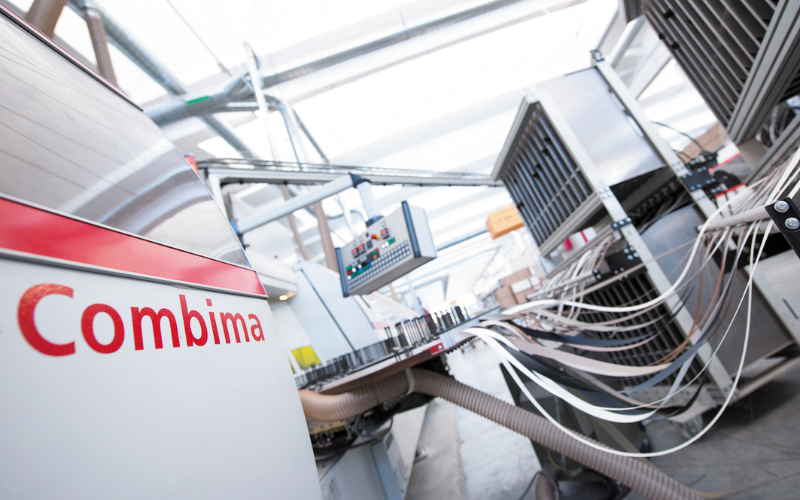
The solutions developed were integrated into a “Combima” machine for format and edge processing, designed for flexible production down to batch size one. The customer now has a single system for the fully automated production of furniture fronts, capable of handling both straight edges and four complex handle profiles. “We met the requirements of our Italian customer by building a high-performance machine, custom-designed for the automated production of components with five different edge geometries“, Dennis Reddig emphasises.
To carry out the numerous processing steps, the machine is equipped with various tools and finishing units, including the I-KFA inside corner rounding unit, profile and flat scrapers, polishing units and brush units. The softforming line for thick edgings extends over a total length of more than 40 metres. “It is a significant size for a machine dedicated to processing furniture components“, Reddig concludes, “but consistent with a special solution developed as a one-off system“.
Read also...

Furniture: how much is the Middle East worth?

How important is Iran for Italian woodworking technologies?

Construction sector, the Italian supply chain holds steady and looks beyond the PNRR: investments on the rise
Industrial Accelerator Act: revitalizing European industry
“I stand with Xylexpo!”: exhibitor support grows stronger