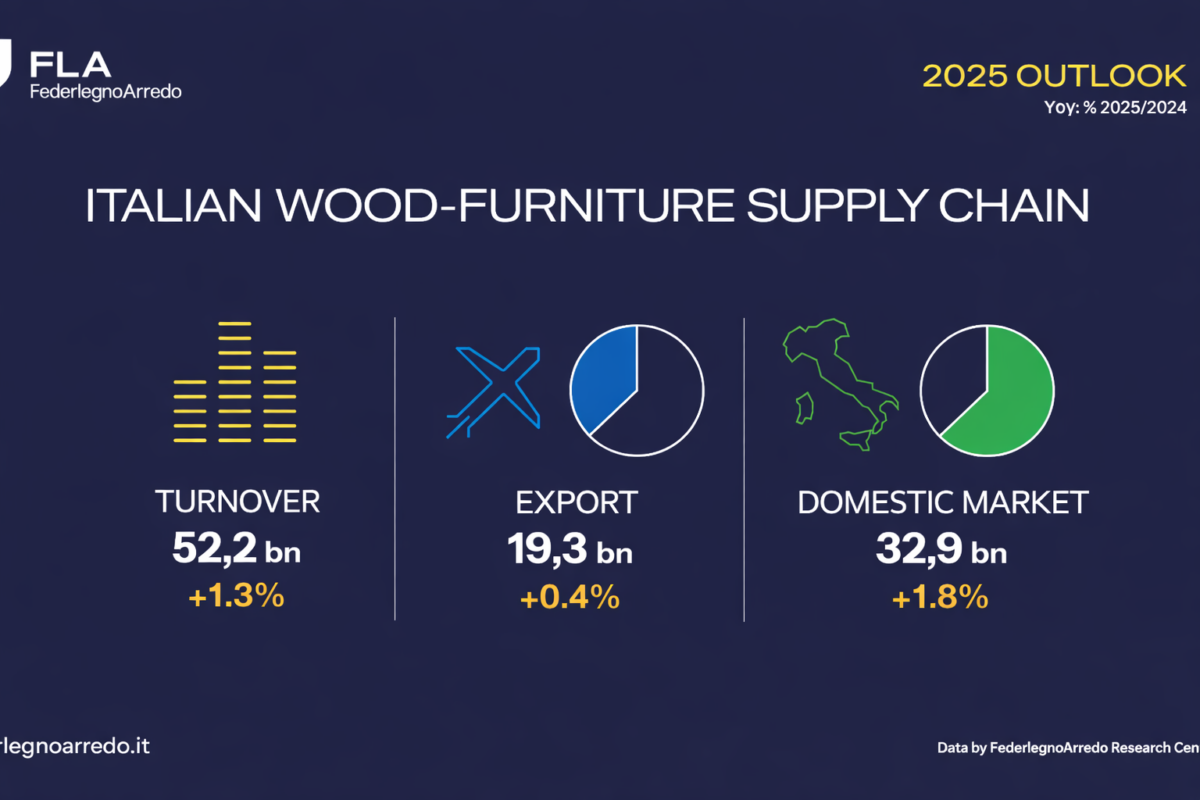
Filiera legno-arredo a 52,2 miliardi: +1,3% in un anno di incertezza
Despite a still uncertain macroeconomic environment, the Italian wood-furniture supply chain closed 2025 with growth. Production turnover reached €52.2 billion, up 1.3 percent compared to 2024, driven mainly by the resilience of the domestic market, which grew by 1.8 percent to €32.9 billion. Exports remained broadly stable (+0.4 percent), amounting to €19.3 billion, despite signs of weakness in key markets such as France and the United States, partly offset by an improvement in Germany. These figures emerge from the 2025 preliminary estimates prepared by the Research Centre of FederlegnoArredo, presented at the launch press conference of the April edition of the Salone del Mobile.Milano.
“These data – comments the President of FederlegnoArredo, Claudio Feltrin – confirm that our supply chain and the entire industrial system it represents, despite operating in a complex, challenging and uncertain context, have been able to implement strategies and actions for adaptation and development that have resulted in overall resilience. We certainly cannot say that we are facing a structural recovery or that we can feel sheltered from the turbulence that 2026 is already bringing, but I do see encouraging signs on which, also as a Federation, we have a duty to focus in order to support our companies.”
The furniture macro-system reached a production turnover of €27.7 billion in 2025, remaining broadly stable (+0.6 percent) compared to 2024. Growth in production for the domestic market (€13.5 billion, +2.1 percent) offset the slight decline in exports (€14.2 billion, -0.8 percent), which continue to account for more than half of total value.
The wood macro-system (including timber trade) grew by 2 percent, reaching a turnover of €24.5 billion. This result was partly driven by price trends and a recovery in exports (€5.2 billion, +3.8 percent). The domestic market (€19.3 billion) recorded growth of 1.5 percent.
EXPORTS
“As regards foreign markets,” Feltrin adds, “our Research Centre, based on data updated to October 2025, highlights an overall trend of substantial stability, with an estimated value of €19.3 billion (+0.4 percent), confirming the strategic weight of exports in the sector’s performance.
Of particular interest within the Top 10 markets is Germany, which in the first ten months of 2025 returned to positive territory (€1.7 billion; +1 percent), while France continues to show weakness (€2.5 billion; -1.3 percent). After the strong expansion recorded in 2021–2022, France has slowed despite a slight recovery in recent months. The United States posted a -2.5 percent decline (€1.7 billion) following the rebound in 2024, with monthly performance influenced by the anticipation of purchases in the spring months ahead of tariffs; this effect was absorbed by July (when the cumulative percentage change was still positive at +0.3 percent), while exports slowed sharply in the following months, particularly in August and October.
Conversely, positive trends are emerging in several European and extra-European markets, helping to partially offset the decline in traditional destinations. Among the countries with the strongest performance in terms of export value growth are the United Kingdom (+4.2 percent), the Netherlands (+8.5 percent) and Spain (+2.3 percent), which climbed to fifth place in the Top 10 destination markets, overtaking Switzerland. Growth was also recorded in markets such as the United Arab Emirates (+3.9 percent), confirming a gradual geographical diversification of foreign sales.”
“Overall, the picture that emerges is one of exports continuing to play a central role for the supply chain, but requiring companies to develop greater adaptability, stronger market presence and diversification, within an international scenario marked by high volatility.
In this context,” Feltrin explains, “I believe our companies have delivered their best, managing to maintain their presence even in markets temporarily facing difficulties, without ever abandoning them and by immediately seizing signs of recovery, as is currently happening in the German and UK markets. I would say we have been effective in diversifying, and that maintaining a presence during the most critical phases has proven to be a rewarding strategy.
All the more so, the Salone del Mobile.Milano confirms itself as a strategic platform for the international positioning of the supply chain, a privileged venue for meeting buyers, operators and designers from around the world, and for strengthening the presence of Italian companies in global markets, offering them a concrete opportunity to consolidate their positioning, engage new stakeholders and access emerging markets.”
Meanwhile, China continues its advance, gaining market share both in Italy and across Europe. “It is enough to note,” Feltrin points out, “that in the furniture macro-system, after a strong second half of 2024, the first ten months of 2025 confirm the trend: +3.7 percent in Europe, -0.3 percent in Italy. At the same time, total imports declined by 7.7 percent, to the benefit of imports from China, which is progressively strengthening its competitive position in the European market, amid growing pressure on Italian exports.”
It is precisely on this issue that President Feltrin returns, calling for action so that “… greater controls are carried out on goods entering our market, in order to prevent unfair competition from countries that manufacture without complying with the rules imposed on European producers. I would like to launch a provocation: instead of focusing solely on tariffs, let us also start thinking about stricter controls on materials and goods entering the market. Checking just 1 percent of incoming flows is certainly not a sufficient barrier to protect ourselves from those who are not required to provide certifications, do not adhere to sustainability standards and do not excel in consumer safety. Otherwise, it will always be an uneven playing field.”
CUCINES
In 2025, the kitchen segment achieved a production turnover of €3 billion, broadly in line with the previous year, with growth of 0.5 percent. This confirms a phase of stability following the three years of strong expansion that characterised the post-pandemic period. Performance was supported by the domestic market, which grew by 3.4 percent to €2 billion, while exports, amounting to around €1 billion, declined by 5 percent after several years of particularly robust growth. The slowdown in exports mainly affected key markets such as the United States and France, while more dynamic signals emerged from countries including the United Arab Emirates and Spain.
BATHROOM FURNITURE
In 2025, the bathroom furniture system generated a production turnover of €4.3 billion, up 1.5 percent compared to 2024, confirming the segment’s overall resilience. Positive performance was driven primarily by the domestic market, which recorded growth of 2.2 percent. Exports, on the other hand, remained broadly stable (+0.5 percent), approaching €1.7 billion and accounting for around 40 percent of total value. In this context, signs of recovery emerged from Germany, which remains the leading destination market.
Read also...

Mexican Market: Biesse strenghthens its presence in Latina America

US trade policy: furniture tariff increases postponed to 2027
Handleless fronts: a new automated edging solution by IMA Schelling

Siempelkamp for Egger: modernization in Wismar
Cecchini Italia partners with Biesse: design, sustainability and innovation