Egger is expanding its offering for timber construction with two new solutions: the “EcoBox” and the “Osb Flammex” panel. The group – specialized in the production of wood-based products and panels – recently introduced these innovations together with an update to its range of finger-jointed roof battens, developed to improve resource efficiency, technical performance and flexibility of use on construction sites.
“ECOBOX”
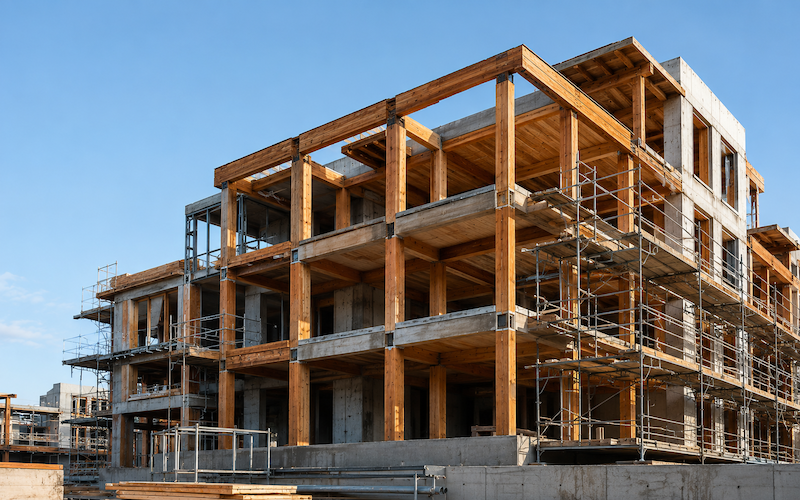
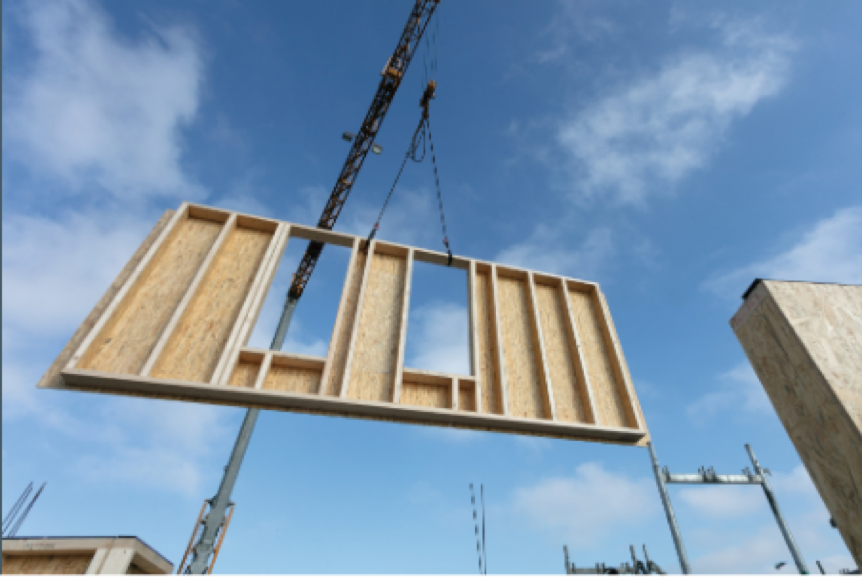
The new “EcoBox” is a hybrid structural element composed of OSB panels, sawn timber and a soft wood-fibre insulation layer. The product is designed as an alternative to solid wood studs in timber frame walls and can also be used as a roofing element, for example as a solution for rafters, beams or parapets. The system is also used in building renovation and façade refurbishment projects.
From a construction perspective, “EcoBox” relies – the company explained – on a combination of materials that makes it possible to achieve dimensional stability while at the same time reducing the overall amount of wood used. Production takes place in an industrial and standardized process with the aim of ensuring consistent quality of the elements. The product is available in lengths of up to six thousand five hundred millimetres, while the width varies between one hundred sixty millimetres and four hundred millimetres depending on market needs and the building’s energy requirements. It is currently offered with a thickness of eighty millimetres and, starting from the second quarter of 2026, a sixty-millimetre version will also be available.
“OSB FLAMMEX”
Alongside the structural solution, Egger has also introduced the “Osb Flammex” panel, developed to address the growing demand for fire safety in buildings. It is a softwood-based panel equipped with a protective coating that reduces its flammability. The product achieves the European classification B-s1, a standard that allows its use in contexts where higher levels of fire protection are required.
The panel is mainly intended for interior applications in buildings with strict safety requirements, such as offices, public facilities, hotels or multi-storey buildings, but it can also be used in other projects where the combination of fire performance and wood-based materials represents a design requirement.
BATTENS
Among the developments announced is also the expansion of the range of finger-jointed roof battens. This technology makes it possible to join several pieces of timber using finger joints, improving the use of raw material and reducing waste thanks to the removal of defective sections of sawn timber. The resulting battens offer mechanical performance comparable to traditional products made from a single piece and maintain good resistance to temperature and humidity variations.
Egger offers these battens in both spruce and pine, thus expanding the available wood species. The introduction of pine – the company explained – also reflects the increasing availability of this species in recent years and its technical characteristics, including relatively high density and good elasticity. The use of finger-jointing also allows the production of elements with more flexible lengths compared with traditional battens, reducing dependence on high-quality long timber boards.