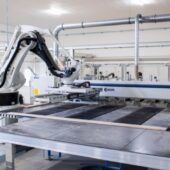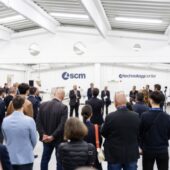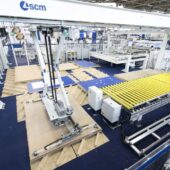
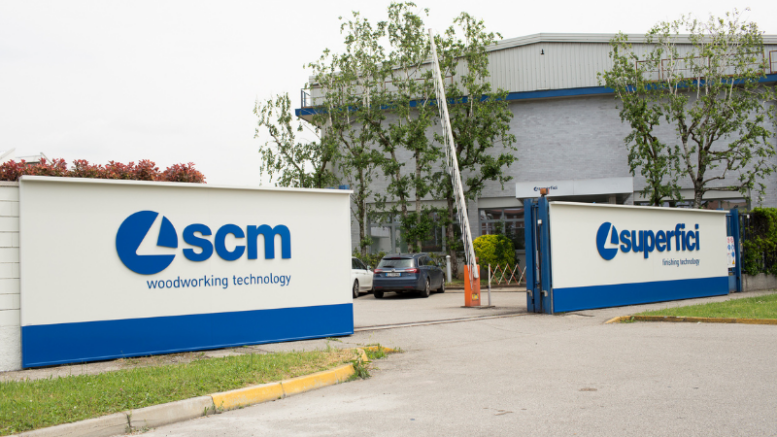
A continuous process, a gradual improvement that at Superfici, a company belonging to the SCM Group, has always been under way, also because coating processes, more than others, were in some way “encouraged” to enter a virtuous cycle…
Finishing and coating processes are undoubtedly the stages in the production of a product, not only wood-based, that have historically had the greatest impact on the environment. It is therefore no coincidence that for decades they have been under the spotlight, with the aim of achieving processes that are incomparably less polluting than they were just twenty or thirty years ago.
It is a compelling topic, which we had the opportunity to discuss with Claudio Baldizzone, who joined Superfici’s engineering department about twenty years ago, later became head of the testing laboratory and for the past five years has been working in technical sales…
“My experience in what is now our ‘Technology Center’ has allowed me to work with techniques and products that enable us to respond to the most diverse requests,” he tells us. “Every day in our laboratories we work to demonstrate how, with the right techniques and products, it is possible to define finishing cycles that achieve exactly the result that is being sought. This is where, using the products and substrates to be coated that the customer brings us, we set up the coating cycle that will then go ‘on line’. It is huge, invaluable experience, which I later had the chance to expand in the world of graphics, as well as by personally experiencing the transition among the various drying systems, from infrared to UV and then to LED.”
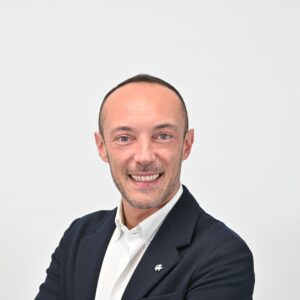
Claudio Baldizzone
And along this path, how has he seen the attention to sustainability change?
“It is a topic to which we have always paid great attention. We knew that in everyday activities one of the priorities was to implement choices and behaviours aimed at improving technologies from the point of view of social, economic and environmental impact. Sustainability does not appear out of nowhere. It is the result of designing better, more efficient machines, which make it possible to create better working conditions and to achieve excellent results with less energy and possibly with reduced quantities of coating products. This also brings measurable economic advantages.
The planet has fortunately begun to follow a decidedly more virtuous path, certainly first taken by the world of coating, paints and application systems. Once the journey began, in a relatively short time we moved from high-solvent-content paints to water-based products, which have a far more limited impact and generate a very, very low environmental pressure. A precious and effective evolution, which has led to cycles that guarantee results while improving the working conditions of operators who previously had to spend eight hours wearing a mask to protect themselves from solvent fumes, just to mention one of the advantages.”
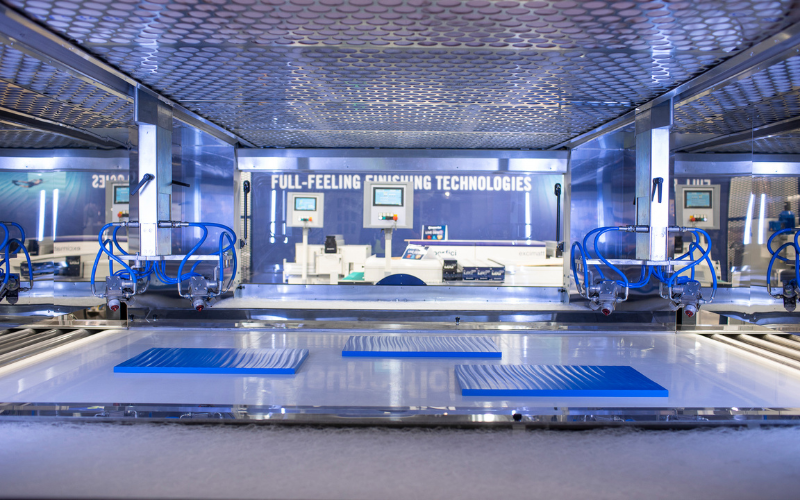
The shift to water-based products has perhaps been the real turning point…
“Undoubtedly. It has had a far greater effect than the introduction of more efficient filtering systems. In the Eighties and Nineties, the focus was on containing emissions into the atmosphere. Today, we reason at the source. The gradual move toward water-based coatings has undoubtedly opened up a new historical phase, reducing the solvent share to percentages that could soon be further significantly reduced.
Another fundamental chapter in this process is represented by the extraordinary development of application technologies and the consequent optimisation of work cycles. For example, we have managed to contain the consumption of the many motors present in a coating line and in extraction and drying systems. We have started to use inverters that allow part of the energy to be recovered, as well as systems that manage the operation of certain equipment, such as extraction or conveyors, so that they operate only when necessary. Improvements that sometimes seem simple, but which lead to extremely significant savings and benefits in terms of sustainability.
Another key piece of the puzzle on which we have focused our efforts is drying systems, in which we have moved, as I mentioned at the beginning of our conversation, from infrared lamps to ultraviolet and recently to LED. These are less energy-intensive choices for which procedures have been developed that guarantee even better results than in the past. Consider that a UV lamp consumes about 120 watts per centimetre of length, meaning that a one-metre lamp burns something like 12 kW. A comparable LED solution consumes half as much and becomes operational immediately, without having to wait for the warm-up times required by old systems or the cool-down time before they can be switched off. LEDs are ‘on/off’. This means that they release energy as the piece passes through and interrupt it as soon as the piece has passed. This result can be managed through intelligent systems that, working on feed speeds and thanks to position sensors, make everything extremely simple, effective and more economical. Another relevant technical step is represented by the greater use of electric systems compared to pneumatic solutions, which are undoubtedly more energy-intensive.”
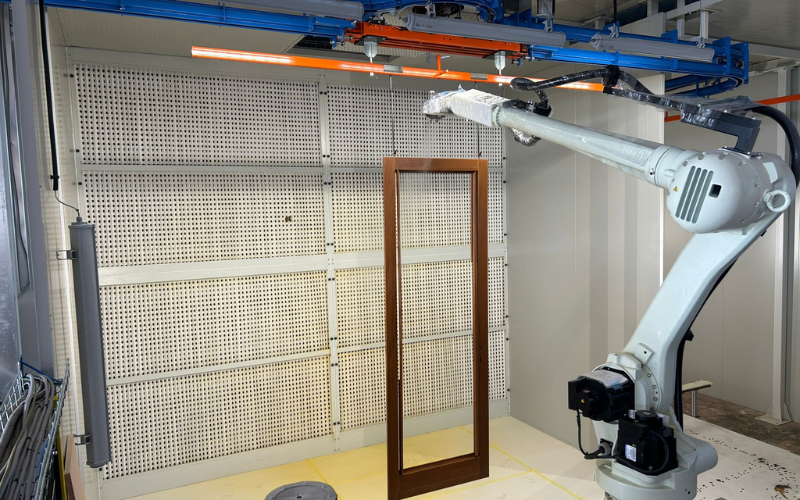
Without forgetting the application of the coating product…
“You are absolutely right. Optimising the use of paint, therefore managing an effective application on the piece, not only improves the overall performance of our machines, to the clear benefit of the customer’s budget, but also reduces waste and disposal costs. Today we boast overspray recovery systems that allow us to re-circulate single-component coatings and reuse them without any problem.
These are technologies that represent the best solution when certain production volumes are involved, even though we have also developed important sustainable solutions for systems that use paper rollers that must later be disposed of. It is no coincidence that the Superfici catalogue includes hybrid solutions, in which it is possible to switch from belt to paper in a simple and quick way in order to always seize the best opportunity.”
Let us satisfy a curiosity. Do customers recognise these efforts? Are they willing to spend more to be more “eco-compatible”?
“Yes, without a doubt. In recent years, sustainability has become an important element in our customers’ choices. They seek information, they ask us questions, they show strong sensitivity, also because these are themes that will later allow a different approach in the proposal to the end customer. Alongside this motivation, which I can say is the most important in the vast majority of situations, systems that allow a more economical process management are also looked at with great attention, for the economic advantage they offer and also for public tools and incentives that reward those who invest in more ‘green’ machines and technologies. Just think of “Industry 5.0” or super depreciation, which we are all waiting for, and which reserve particular ‘attention’ to those who choose less impactful technologies.”
So can we sleep soundly?
“Attention must remain high. At Superfici, the word ‘sustainability’ has always carried great weight, a weight that has grown even further over the past ten or twenty years. We must always keep in mind that every application methodology, veil, roller or spray, has characteristics that cannot be overturned. Each is more suitable for certain uses and for each it is possible to find specific ‘sustainable solutions’, but there is no magic wand that works in the same way for everything.
Our strength lies in having the skills to achieve the best in every segment, drying included. And when it comes to drying, it should always be remembered that, in general terms, shorter drying times involve greater energy usage. This makes it essential to apply the right and necessary amount of coating in order to then achieve an ‘economical’ drying process, both in terms of energy and waiting time for the dry piece. Finding the right balance point among needs that sometimes push in different directions is where our ability to work alongside our customers lies, by ‘bringing together’ all the values to write an equation whose result is as positive as possible.
You see, coating is a mix of many elements, substrates, application systems, coatings, drying ovens, just to mention the most evident ones. With our solutions, we guarantee processes that are as sustainable as possible. Coating manufacturers seek increasingly eco-compatible formulas and those who apply coatings tend to combine environmental respect with ‘acceptable’ costs. Everyone plays their part in a particularly complex process that leads from a semi-finished, raw element to something ‘finished’, which will be assembled into a product that must not only be aesthetically pleasing, but also resistant, useful and used.”
Have we arrived? Is this the best of all possible worlds?
“As we have already said, coating has always had a very close relationship with sustainability, precisely because of what it is, what it does and what it is used for. We have done a great deal, a great deal indeed, thanks to the collaboration among all the players in this segment, but there is certainly room for further improvement. We have found the right path and we are following it, but we have not yet reached the end. We will continue to improve our technologies, just as chemistry will continue to provide us with better coatings. However, there remains one big question mark, namely the taste of the end consumer, who is the driving force behind this whole process. If the new generations, as it seems, will be willing to follow the path of sustainability together with us, then we will be able to be even much more ‘green’, I am sure of it…”
https://www.scmgroup.com/it/superfici