That sustainability is the key word of our time is evident. Everyone talks about it, everyone pursues it. From environmental sustainability to social sustainability, through ESG indicators, it has now become a benchmark, a measure for assessing corporate value and, often, also a communication tool.
Yet between slogans and good intentions, there is the risk that the term loses weight, turning into a label rather than an operating principle. In this scenario, Valcucine chooses a less rhetorical approach. It considers sustainability not as a goal to communicate, but as a design and industrial criterion to be applied, in a measurable way, in everyday practice.
The starting point is a clear observation: sustainability is not enough if it is not perceived as a concrete value. According to the research “Keys to Making Sustainable Products Mainstream” by BCG, 80 percent of consumers say they are disillusioned with environmental progress, and only a minority believe they can make a difference through their choices. However, more than a third would willingly choose sustainable products if these offered tangible benefits in terms of aesthetics, functionality or comfort. The challenge, therefore, is not only to “do good”, as the Italian company explained during the “Spring Edition of the Green Design Days”, an event organised by FederlegnoArredo to celebrate the Federation’s 80th anniversary, but to make good desirable. A sustainable product must improve the life of the person who uses it.
REDUCING MATERIAL, INCREASING MEANING
In the world of kitchens, Valcucine translates this idea into a key principle: dematerialisation, meaning the reduction of the amount of material used without sacrificing strength, aesthetics or durability.
The “Artematica” door, for example, uses a panel only five millimetres thick applied to an anodised aluminium frame, achieving material savings of up to 85 percent compared with a traditional door. The insertion of a honeycomb carbon-fibre panel ensures strength and lightness, while reducing energy consumption and production impact.
Lightness, in this case, is not merely a technical matter but a cultural choice. It means removing what is superfluous to make room for substance.
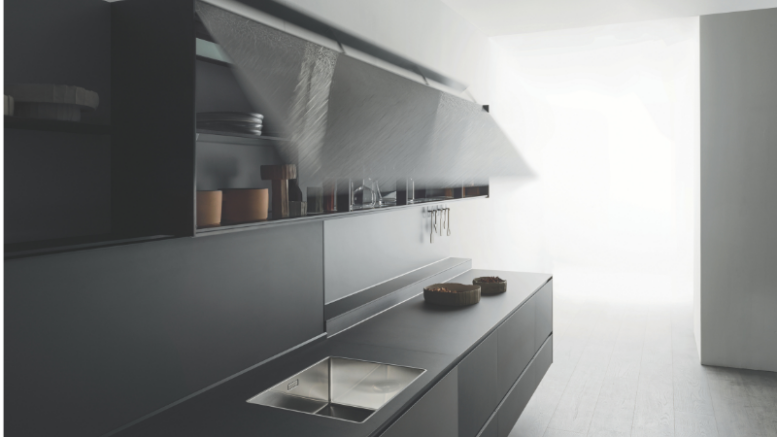
Another cornerstone of the company’s philosophy is reversibility, that is, the possibility of dismantling and recycling every component. The “Invitrum” system, the world’s first kitchen made entirely of glass and aluminium, was created precisely with this goal in mind. The exclusive use of mechanical joints instead of glues eliminates toxic emissions and enables full material recovery at the end of the product’s life.
Glass, Valcucine’s symbolic material, is fully recyclable and processed with water-based paints, safeguarding both the environment and human health.
This approach also translates into transparency. Today, the company is the only one in the industry able to contribute up to 12 LEED credits (LEED credits measure the contribution of a building or its components to environmental sustainability, ed.) according to the LEED v4.1 protocol within certified construction projects.
INNOVATING BY SUBTRACTING
For Valcucine, sustainability does not mean adding “green” technologies, but optimising what already exists. In the “Aerius” wall unit, for example, gravity replaces pistons and hinges, reducing parts subject to wear. In the “V-Motion” system, touchless interaction simplifies movements and limits mechanical components. These are solutions that subtract complexity and consumption, turning technology into an ally of efficiency rather than a source of waste.
Sustainability, for Valcucine, also coincides with well-being in living spaces. Ergonomics, with deeper worktops, adjustable heights and intuitive openings, and light management through systems such as “V-Light”, which follow the circadian rhythm, become an integral part of design. This is an approach that connects environment and people, because a sustainable project is one that lasts over time and improves the life of those who use it, as the company explained.
Durability, in fact, is the other side of sustainability. It means opposing planned obsolescence and building objects designed to last. Craft finishes, high-quality materials and an aesthetic not subject to fashion aim to make the kitchen an investment rather than a consumable product.
In a time marked by “eco-fatigue”, where an excess of green messaging has generated more scepticism than awareness, the real challenge is to shift the narrative of sustainability from “because it is right” to “because it is worthwhile”.
It is a cultural challenge even before a communication one. It aims to redefine the relationship between design and consumption in a more mature, informed and pragmatic way. It is an approach in which beauty does not conflict with responsibility and which shows, once again, how every design choice can become an active gesture toward a more conscious way of living, capable of combining the urgency of the present with a vision for the future.
VALCUCINE
Founded in Pordenone more than forty years ago, Valcucine operates in the design kitchen sector with an approach that combines technological research, material quality and close attention to environmental issues.
Since the 1990s, the company has oriented its production toward reducing environmental impact, introducing the concept of dematerialisation and developing recyclable aluminium and glass components.
Its kitchens stand out for their structural lightness, the use of reversible materials and the possibility of disassembly at the end of their life, in support of a circular production model.
Today, the company integrates ESG objectives into its processes and monitors its impact according to internationally recognised criteria such as the LEED protocol.
Valcucine is present in several international markets, with a network of showrooms and ateliers across Europe, the United States, the Middle East, India and South-East Asia.