Woodworking technology: the global markets keep waiting…
In a scenario where, unfortunately, the same old game is still being played – with markets that have been closed for years and a persistent stagnation in the demand for goods of all kinds – even the woodworking and furniture technology industry is struggling to find new paths forward.
Although the search for new outlets and new opportunities continues, domestic and international demand is certainly not generous with satisfaction: a fact that emerges in all its clarity from the economic analysis carried out by the Acimall Studies office, the association that represents the excellence of the Italian offer in the industry.
The survey, conducted every three months on a representative sample, shows that in the July-September 2026 period, orders grew by a modest 1.2 percent compared to the same period in 2025, down from the 5.3 percent increase recorded in the previous quarter. Demand from abroad for “Made in Italy” products grew by 1.7 percent (compared to 12.3 percent in the April-June 2026 period), while orders from the domestic market fell by 0.7 percent relative to the same quarter in 2025, a figure that is certainly more “encouraging” than the 12.3 percent decline recorded in the April-June period.
The order backlog stands at 3.6 months (compared to 3.5 in the previous quarter), alongside a significant recovery in prices, which have risen by 4.3 percent since January 1st of this year (up from 3.5 percent as of June 30th).
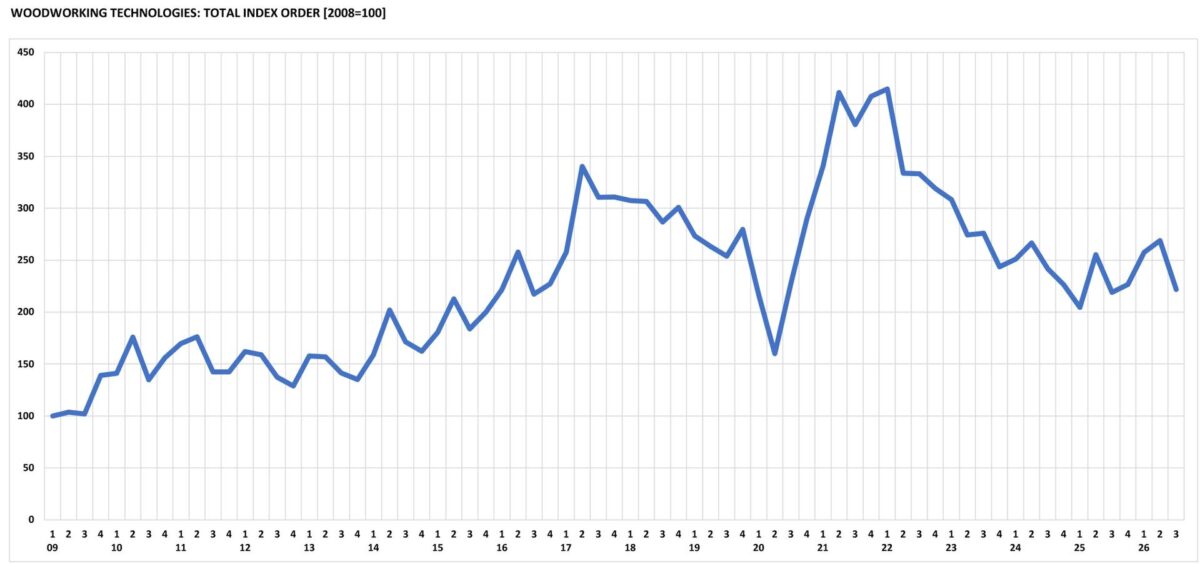
The quality survey reveals that 24 percent of the sample reports an increase in production (compared to 18 percent in the previous three months), 41 percent is experiencing a period of substantial stability (59 percent in the April-June period), while 35 percent reports a decline (23 percent three months ago). So, a glimmer of light seems to be emerging, at least when taking into account the data from the quality survey. Employment levels remain stable (88 percent of the sample), with 6 percent reporting an increase and the same percentage reporting a decrease. Available stocks are stable according to 65 percent of the sample companies, increasing for 18 percent and decreasing for 17 percent.
The insights emerging from the forecast survey are, as always, invaluable; they outline the sector’s expectations for the months remaining in this “complex year.” 65 percent of the sample anticipates a “stable” season for domestic orders (with 23 percent expecting a decline and only 12 percent anticipating growth). For foreign orders, this figure drops to 53 percent, with 18 percent of the sample expecting an increase and 29 percent anticipating a decrease.