The new Machinery Regulation: revising the ISO 19085 standards
On 20 January 2027, Regulation (EU) 2023/1230 will become applicable, replacing Machinery Directive 2006/42/EC. Much of the attention so far has focused on the changes introduced by the new legislative framework, but work has long been under way on a less widely known and equally important front: updating the harmonised technical standards.
For the woodworking machinery sector, this means revising the entire ISO 19085 series, the international reference for woodworking machinery safety. It is a demanding task, involving the simultaneous revision of eighteen standards under a particularly tight deadline.
Why do all the standards need to be updated? The main reason is that the new Regulation introduces essential health and safety requirements (EHSRs) that were absent from Directive 2006/42/EC.
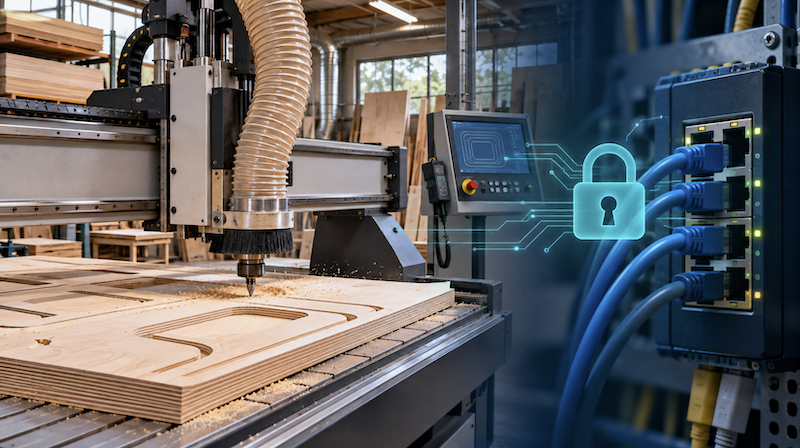
The most significant of these is the new EHSR 1.1.9, which addresses cybersecurity. The current harmonised standards were developed under the Machinery Directive and contain neither requirements nor technical solutions covering this new aspect. As a result, their references may initially be published under Regulation (EU) 2023/1230 with the cybersecurity requirement outside their scope of coverage.
This has practical implications, particularly for machinery subject to more stringent conformity assessment procedures. For machinery listed in Annex I, Part B of the Regulation, which corresponds to the former Annex IV of the Directive, manufacturers may use internal production control only if the applicable harmonised standard covers all relevant essential health and safety requirements. Otherwise, the Regulation requires manufacturers to use another conformity assessment procedure, such as EU type-examination by a notified body.
This provision makes updating the technical standards essential.
The relevant ISO working group began a full revision of the ISO 19085 series in 2024. The task involves both updating eighteen standards and developing cybersecurity requirements from scratch for woodworking machinery to address the new provisions of the Regulation.
The revision starts with ISO 19085-1, which sets out the common requirements for machinery across the sector and serves as the basis for the subsequent parts covering individual machine types.
Acimall, the association of Italian woodworking machinery manufacturers, has been directly involved through its participation in international standardisation work. The author of this article, who heads Acimall’s Technical Department, chairs the ISO/TC 39/SC 4 subcommittee and serves as convenor of the working groups revising the ISO 19085 series.
The aim is to provide manufacturers with a set of harmonised standards that allow them to meet the new requirements of the Regulation while taking account of the technical characteristics of woodworking machinery.
The original plan was to refer to the forthcoming type-B standard EN 50742, which addresses machinery cybersecurity. During the revision, however, it became clear that the standard was still under development, that its timetable did not align with the date on which the Regulation would become applicable, and that its scope was deliberately broad.
The working group therefore chose to develop cybersecurity requirements directly within ISO 19085-1, tailoring them to woodworking machinery and making them straightforward for manufacturers to apply.
A RACE AGAINST TIME
Developing an international standard normally takes three years. A fast-track procedure was adopted in this case, but the simultaneous revision of eighteen documents remains an exceptional undertaking.
ISO 19085-1 is now at an advanced stage. Following a favourable final assessment by the European Commission’s harmonisation consultant, it has moved to the formal vote, which closes on 21 December. Subject to final checks and typesetting, publication could follow as early as January 2027.
Many of the machine-specific parts of the series have also passed the public enquiry stage, and a substantial number could be published by March 2027. Even after publication by ISO and CEN, however, the European Commission will still need to complete the harmonisation process by publishing the references in the Official Journal of the European Union. This is an essential step, and its timing is outside the control of the technical working groups.
IMPLICATIONS FOR MANUFACTURERS
Updating the standards is an essential step in supporting the application of the new Machinery Regulation.
To address the difficulties arising from the harmonisation timetable, industry associations have asked the European Commission, through Confindustria, to postpone the application of the new requirements, including the one on cybersecurity. The Commission has yet to respond.
In the meantime, manufacturers of machinery listed in Annex I, Part B will need to consider carefully which conformity assessment procedures to use during the transition, taking into account the status of the new harmonised standards.
The work on ISO 19085 will help determine which technical tools the woodworking machinery sector can use as the new Machinery Regulation becomes applicable.
CYBERSECURITY IN WOODWORKING MACHINERY
Introducing cybersecurity requirements is one of the most demanding aspects of the ISO 19085 revision. The initial plan, as noted above, was to refer to the forthcoming EN 50742, a type-B standard on machinery cybersecurity. As work progressed, the group identified an opportunity to develop requirements tailored to woodworking machinery.
A type-B standard must apply, as far as possible, to machinery and installations across many different sectors. EN 50742 therefore has to cover a wide range of scenarios, many of which are irrelevant to woodworking machinery. Designers applying the standard must still carry out a machine-specific risk assessment.
The type-C standards in the ISO 19085 series are written for individual families of machines and already take their specific risks into account. This allowed the working group to focus on the cybersecurity issues relevant to those machines and translate them into practical requirements for manufacturers.
The guiding principle is proportionality. A malicious act that causes a system to shut down or lose functionality can have very different consequences depending on the application. In some cases, an interruption can directly endanger people. Examples include certain ventilation systems in hospitals or mines, or lifts in large public buildings. In woodworking machinery, a shutdown in itself does not normally pose a risk to the user.
The working group also chose to use established terminology and tools, drawing on the IEC 62443 series, which is already widely used in industrial cybersecurity. In particular, it adopted the concepts and definitions associated with security levels (SL), allowing it to use an existing classification for woodworking machinery.
This has a practical advantage. Some IEC 62443 standards cover electronic components with cybersecurity functions and use the same security levels. Machinery manufacturers can therefore work with concepts already used by component suppliers, making it easier for machine designers and electronics suppliers to communicate.
Perhaps the greatest challenge was determining what cybersecurity requirements are reasonable and proportionate for woodworking machinery. Unauthorised interventions can take many forms, with varying likelihoods and consequences. Developing the standards therefore involves judging which measures are necessary for safety and which, though technically feasible, would be disproportionate to the actual risks posed by the machinery.
Meanwhile, work on EN 50742 has also accelerated. CEN has placed the standard on a priority track because several sectors are awaiting its publication. It could therefore be published in time for the new Regulation to become applicable.
For the woodworking machinery sector, the work on ISO 19085 is intended to give manufacturers clear, specific cybersecurity requirements proportionate to the characteristics of their machines.
For any machine-specific parts of the ISO 19085 series published after 20 January 2027, the sector will need to determine how best to manage the transition. One option under consideration is to apply the previous edition of the relevant type-C standard alongside EN 50742 until the revised edition is available and harmonised.
Matteo Simonetta
Acimall Technical Department