Superfici: more efficient window and door frame coating with “Robot Maestro”
Reducing energy consumption, optimising the use of raw materials and limiting waste generation are increasingly important objectives in industrial finishing processes. In the coating of wooden window and door frames, in particular, automation represents a means not only of improving quality and process repeatability, but also of enhancing the overall efficiency of the production cycle.
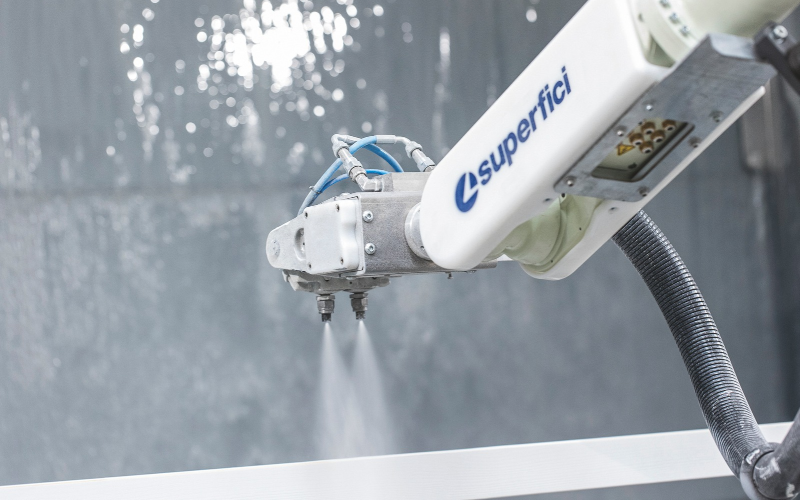
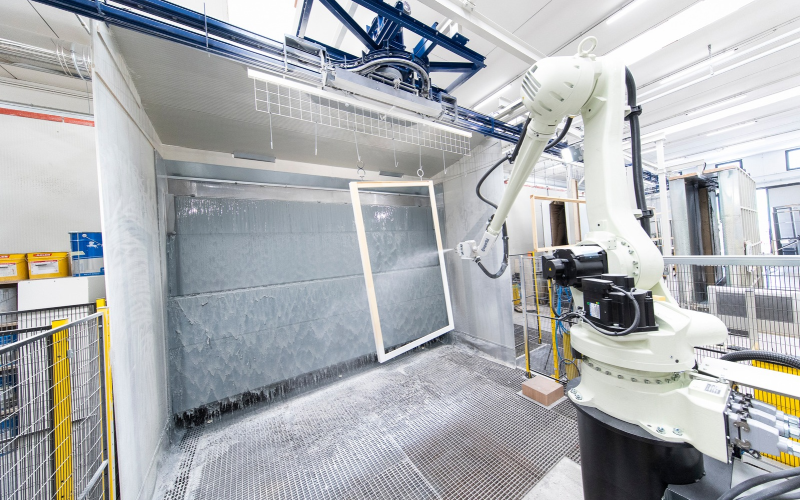
Against this backdrop, Superfici, an SCM Group company specialising in industrial finishing technologies, has developed a range of solutions. Among these, “Robot Maestro” is an automated spray coating system for window and door frames, designed around the arm movements of a craftsman. The robot automatically reproduces the spray paths required to coat three-dimensional workpieces, ensuring repeatability and application quality.
Coating automation can also have a positive impact on overall process efficiency. In the case of “Robot Maestro”, this is achieved through technical solutions that allow spray booth ventilation to be adjusted according to the different stages of the cycle, while optimising spray gun management and spray paths.
VENTILATION ONLY WHEN NEEDED
One of the most significant aspects concerns the management of spray booth ventilation. In a standard manual spraying configuration examined by Superfici’s product development team, the fans operate at their full combined power of 6 kW, with an extraction airflow rate of 18,000 cubic metres per hour.
Through its control system and an inverter, “Robot Maestro” automatically adjusts ventilation according to the operating stage. In the example cycle examined, ventilation operates at 20 percent when the workpiece enters the booth and during carrier rotation, reaching 100 percent during the two spraying stages.
“Under these operating conditions, electricity consumption for ventilation is reduced by approximately 30 percent compared with the manual configuration considered. The same adjustment also affects the energy required to compensate for the heat loss associated with the air extracted from the booth: the reduction in consumption indicated in the documentation is 34 percent”, the company explained.
“The figure refers to the specific booth configuration and operating conditions considered in the calculation: an extraction airflow rate of 18,000 cubic metres per hour, two 3 kW fans and a temperature difference of 10 degrees Celsius between the outside air and the indoor environment. It should therefore not be generalised to all systems or production conditions”.
OPTIMISED SPRAYING
A second contribution to process efficiency comes from independent spray gun control and the optimisation of spray paths. According to Superfici’s technical staff, these solutions enable a reduction in coating material consumption of between 20 and 30 percent compared with the manual spraying configuration used as a reference.
Reduced material consumption also leads to a decrease in the amount of compressed air required by the high-pressure pump. In the case examined, the production of compressed air associated with the pump requires an electrical power input of 0.6 kW. Applying the 20-30 percent reduction in coating material consumption, the technical calculation estimates electricity savings of between 210 and 310 kWh per year, assuming eight operating hours per day for 220 days a year.
“Once again, the figure is linked to the operating conditions used for the comparison and should therefore be interpreted within that specific scope of analysis”, the company pointed out.
LESS WASTE
“Optimising the amount of coating material sprayed also affects the frequency of spray booth filter replacement. In the comparison reported by Superfici, filters are replaced every three weeks with manual spraying, for a total of 16 replacements per year. With ‘Robot Maestro’, the interval considered increases to four weeks, reducing the number of replacements to 12 per year. Taking into account the labour time required for each filter replacement, the overall time is reduced by approximately 30 percent”.
The amount of spent filter material requiring disposal as special waste also decreases when switching from manual spraying to “Robot Maestro”: a reduction of 28 percent, based on the operating conditions considered in Superfici’s technical documentation.
“In light of all the benefits described, with Superfici’s ‘Robot Maestro’, spray coating automation becomes a strategic tool for more accurately monitoring and quantifying the resources used in the finishing process”.
Read also...
SCM introduces the new “gabbiani af” range
Industrial sustainability: Cefla Finishing technologies
Egger completes Markt Bibart expansion
Biesse named 2026 Export Champion for Italy’s Marche region
Italy’s machinery exports: over 23 billion euros in untapped potential