The art of drying
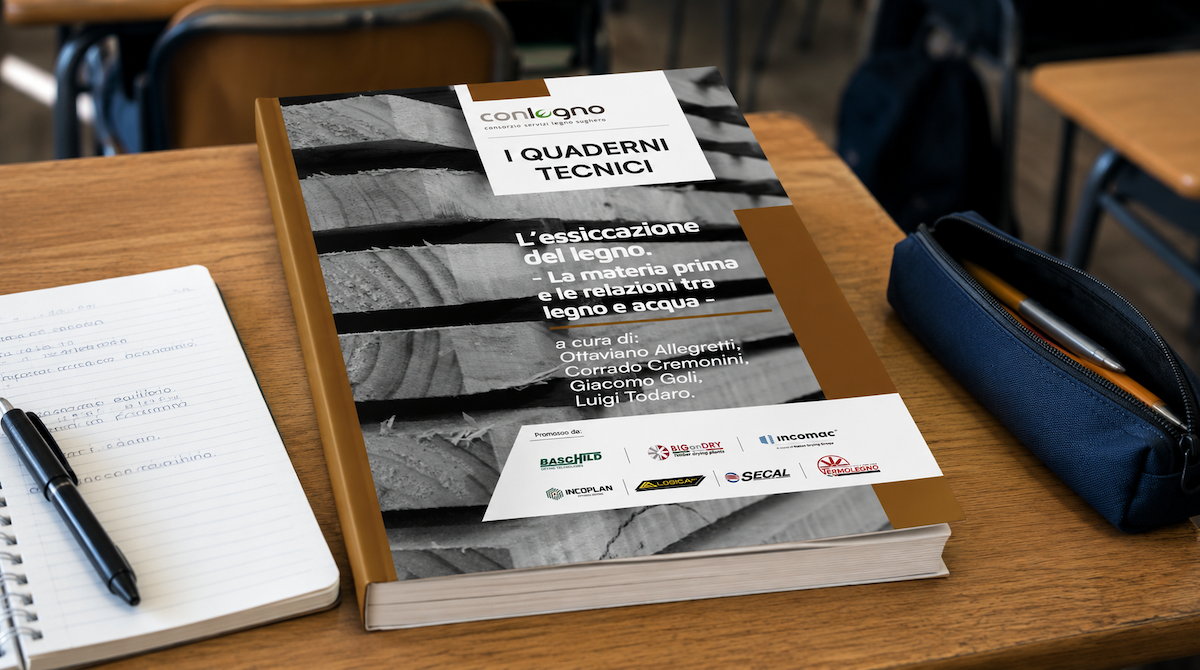
The challenge of transmitting knowledge, codifying experience and organizing a world of practices, methods, inventions, tools and ideas has always been a demanding one. What we like to call the “wood drying manual” – although its actual title is far more articulated and comprehensive (“Wood drying. Raw material and the relationship between wood and water”) – fills a gap in one specific segment of wood processing, namely drying, on which almost nothing has been written. The valuable work promoted by Conlegno – a non-profit consortium created to protect forest heritage and biodiversity by encouraging the use of wood, from raw material to packaging and structural timber – will be previewed at the next Xylexpo, where it will be one of the most interesting moments in the programme scheduled at the “Xylexpo Arena”.
The volume – coordinated by Professor Giacomo Goli of the University of Florence and developed with the collaboration of Dr. Ottaviano Allegretti of CNR IBE and Professors Corrado Cremonini of the University of Turin and Luigi Todaro of the University of Basilicata – aims to provide a comprehensive examination of drying, from the raw material to the industrial systems that make the process fast, reliable and versatile, enabling the best possible results with any wood species.
It consists of thirteen chapters: the first deals with wood as a material, analysing its constituents. The second presents it as a raw material, describing its structure and main characteristics; the third examines the transformation processes of humid air, while the fourth focuses on the measurement of relative humidity through the three reference methods. Chapter 5 is devoted to desorption energy, while the sixth defines wood moisture content, the types of water contained in wood, levels and other parameters. The following chapter illustrates the four measurement methods for solid wood and wood-based panels, while Chapter 8 addresses the movement of water within wood. Chapter 9 focuses on transport times in the various biological components of the wood material, while the next three chapters are dedicated to in-service moisture content, shrinkage and swelling, and the expected deformations in sawn timber. The final chapter illustrates the various mechanical behaviours. All the topics covered provide the necessary foundation for the issues that will be addressed in the subsequent Volume II, which will deal with industrial processes such as steaming, drying and thermal treatments.
It is, therefore, a complete and thorough treatment of the relationship between wood and water, born from Conlegno’s desire to fill a bibliographical gap that has been felt in Italy for many years. Suffice it to say that the last reference texts date back to the fundamental works of Professor Giordano and the publications of engineer Cividini, figures who made the history of wood culture and processing, but whose works have not been updated for decades and are now out of print. And not only in Italy: work is already underway on an English-language translation, because this is a publication that is also strongly needed beyond national borders…
And there is more: this first volume will in fact be only the first step, to be followed in 2027 by the publication of a second volume, already “in progress”, which will be devoted to the more “practical” aspects, industrial drying processes, the different technologies currently available and the issues arising from steaming, drying and thermo-treatment processes.
“The publication of technical volumes in Italy is becoming an increasingly rare event in the national publishing landscape”, the authors commented. “This is also due to the evaluation metrics used for academic career advancement, which are primarily oriented toward short, international scientific output and do not reward handbook-style synthesis. We undertook this work driven by the belief that universities and research institutions must play a fundamental role in transferring and updating knowledge. In academia, this process is defined as the ‘Third Mission’ and, together with teaching and research, constitutes one of the institutional pillars of every university”. They added: “This volume was conceived to ensure that our daily work can be beneficial to companies, by providing a tool capable of combining scientific rigour and practical aspects, thereby supporting the updating of skills across the wood supply chain”.
Read also...

Wood drying: technology, energy and skills at the centre of the debate
Altendorf concentrates production in Minden

Dürr, new metering pump for industrial coating applications

Energy renovation: a challenge involving the wood industry as well

Raute, EUR 31 million order to expand plywood production in Estonia