Conlegno: the enthusiasm for building expertise!
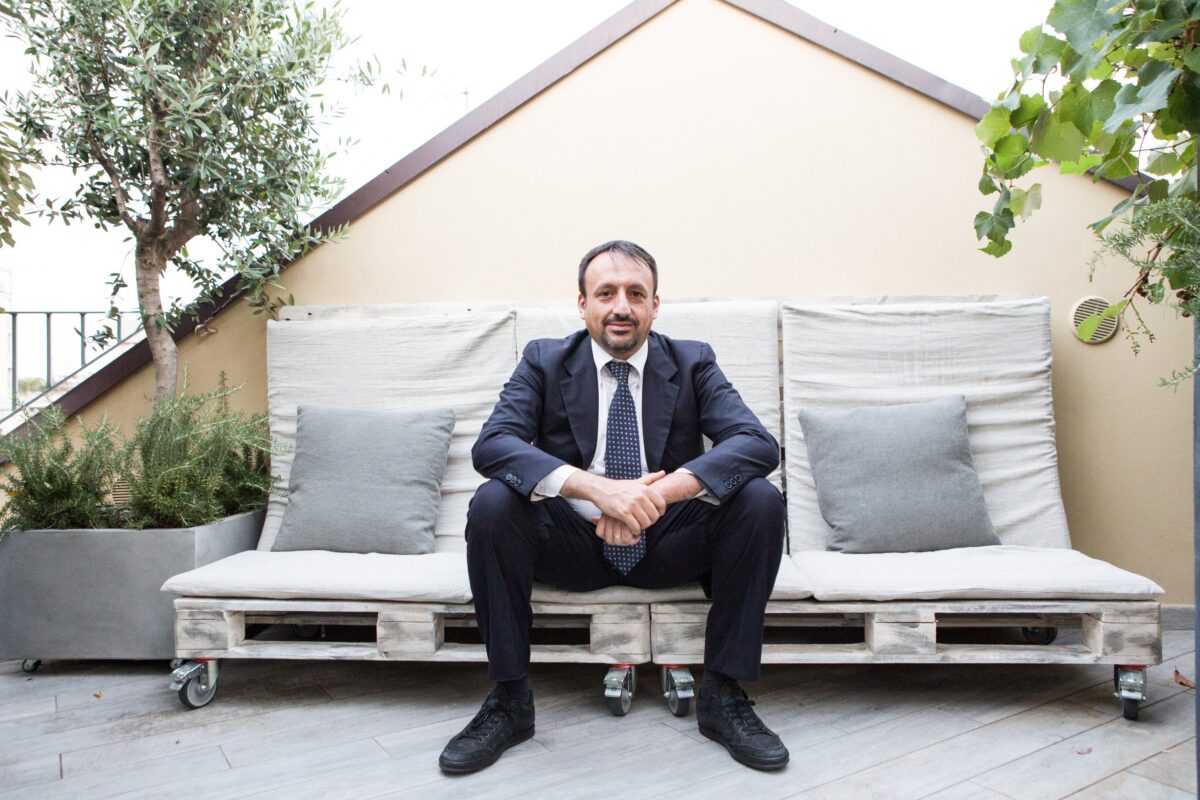
How can we introduce Sebastiano Cerullo and the conversation we had the pleasure of sharing with him? And what can we say about Conlegno, the organisation, the consortium he was already managing before it formally came into being and through which he has built exceptionally strong relationships with hundreds of companies across the sector, from north to south and east to west, especially with that part of the supply chain closest to his roots?
First and foremost, Cerullo’s own roots. A graduate in Forestry Sciences, after working as a researcher at the CNR, Italy’s National Research Council, he joined FederlegnoArredo, where he served as General Manager from 2017 to 2022. A story that came to an abrupt end, but which did not distance Cerullo from his roots. Those roots are also Conlegno’s roots: an organisation he helped bring into being and of which he remains Secretary General, now devoting all his energy to it.
And then there are the roots of the supply chain itself, which has always been, and probably always will be, divided between two souls that struggle to agree on every decision. One is closer to wood as a “raw material”, encompassing woodland, forests, renewable energy and primary processing. The other has risen into the realm of beauty, style, ingenuity and the creativity embodied by furniture and interiors that have made Italy a global benchmark.
But let us return to Conlegno, the central focus of the story we are trying to tell in these pages. The fact that Sebastiano Cerullo can now devote himself to it body and soul undoubtedly opens a new chapter, establishing the organisation as a highly regarded “service hub” at the centre of such a vast range of activities that even attempting to describe them can feel daunting. And should you doubt it, simply visit Conlegno’s brand-new website at [www.conlegno.eu](http://www.conlegno.eu) and open the “Our History” page.
“The roots, to stay with the metaphor, run very deep,” Sebastiano Cerullo told us. “We began in 1998 with the Qualipal Italia consortium. I had just entered the world of business associations to manage the EPAL trademark, which marked a new chapter in a complex period for pallets, at the centre of a world increasingly shaped by the globalisation of trade. EPAL represented the creation of a sort of international single currency: one standard format and very precise characteristics, whatever the destination or country of origin. I should say that even today, although Conlegno has chosen to move in many other directions, the packaging sector still accounts for a significant part of its activities.
A few years later, we created the FitOk technical committee and the corresponding trademark, which we still manage today under authorisation from the Ministry of Agricultural, Food and Forestry Policies. It certifies that wooden packaging complies with the international ISPM 15/FAO standard for phytosanitary treatments, ensuring the safety and free movement of packaging in more than 180 countries worldwide. It was an important step for companies because it transferred expertise in this field away from the regional authorities, which too often operated independently and created “confusing” situations, to an organisation capable of harmonising the system. The result was that, within just a few years, the 150 companies involved in EPAL activities grew to more than 1,500…”
… the first chapter in a long story…
“Exactly! And I am pleased to recall what I consider the most significant milestones. I am thinking of 2010, when we recognised the growing importance of the EUTR, the European Union Timber Regulation, EU Regulation No. 995/2010, which prohibits the placing on the market of illegally harvested timber and related products. Within three years, and thanks to collaboration with other organisations, Conlegno became the first monitoring organisation recognised at European level, providing a tool greatly appreciated by companies, from major furniture groups to timber traders.
It was around the same time, if I remember correctly, that we began focusing on structural timber, obtaining ETA, European Technical Approval, for chestnut beams, which until then had not been covered by any certification. We pursued similar initiatives for spruce and larch Uso Fiume and Uso Trieste beams, obtaining European approval through a joint effort with several Austrian companies, and for structural matchboarding.
Another major step in the field of structural timber came in 2015 with the creation of the SALE certification, the Wood Reliability System. For the first time, there was a document capable of reassuring banks, which until then had been rather “reluctant”, if not openly opposed, to granting mortgages to people wishing to live in timber houses. It was a change that I would not hesitate to describe as historic and which had a major impact on the subsequent success of timber construction.”
Dr Cerullo, we understand that the key to your work lies in solving practical problems…
“Exactly. Conlegno is a not-for-profit organisation and is an expression of the associations that founded and continue to support the consortium: Confartigianato, CNA, Confapi, Filiera Legno and others. These national organisations amplify our message and, at the same time, represent a fundamental pool of users. As Article 2 of our statute states, ‘the general purpose of the consortium is to encourage and implement the many uses of wood, cork and other agricultural and forestry products, and to promote quality among companies operating in the wood sector and related industries’. We do this every day by listening to companies, without imposing solutions from above, but responding to needs emerging from local areas. We are fully aware that, in the overwhelming majority of cases, our counterparts are highly practical small and medium-sized enterprises, for which we have become an important point of reference.
Not only that: we chose to adopt a very “precise” statute and to establish a guarantee committee made up of distinguished university professors and legal experts, who ensure that the rules are clear for everyone.
Today, 28 people work in our offices and they all share one priority: helping companies overcome the “difficulties” that may arise when applying new regulations or dealing with bureaucracy. I am thinking of the more than 400 companies certified according to PEFC and FSC protocols, or of the commitment that drives us to remain constantly active across the country, speaking not only about our services but also about the urgent issues facing a sector undergoing rapid and continuous transformation. For us, ‘listening, dialogue and local presence’ is a mantra to be applied every day. And we do so with particular attention to the characteristics and customs of the region or area in which we are working. To give you and Xylon’s readers one example, we have recently confirmed that in Sicily it is more useful to talk about timber construction, because in that region, as in others, it is experiencing a genuine boom!
Just to give an example of what it means to know companies and visit local areas: at Conlegno’s most recent Assembly, between businesses attending in person and those represented by proxy, we exceeded 800 companies, an absolute record for the wood sector. No Italian association or organisation is capable of achieving a result of this kind.”
“Over all these years,” continued Conlegno’s Secretary General, “we have met hundreds upon hundreds of companies run by remarkable people, who must deal with increasingly complex regulations and feel a strong need to rely on knowledgeable and well-trained experts. Not only that: many of these companies are undergoing generational transitions that are leading them towards new directions, where having access to a comprehensive perspective, such as the one Conlegno can offer, becomes especially valuable.
We are competent and, allow me to say, perhaps this is our greatest strength, although unfortunately we do not communicate it very well. We can provide so many services because every activity and each of the many initiatives we pursue is entrusted to extremely capable people, very often genuine leading experts at national and even European level. It is this expertise that has earned us recognition and opened doors. We all know how increasingly scarce specialist knowledge has become in the wood sector. Fortunately, the choices we have made and the opportunities we have seized have enabled us to bring together within Conlegno those who still possess this knowledge, effectively creating ‘schools’ in which expertise is not only collected, but also experienced and shared.
This year we launched the PalVision software for designing pallets of every kind, and do not forget that there are more than 250 different types, calculating their load capacities and other requirements that will become essential in view of the new regulations soon to come into force. Still in the packaging field, we are launching the QRM, Quarantine Risk Management trademark, because it is not enough for a pallet to be FitOk-certified: all the potential risks that may arise during transport must also be understood.
We are doing excellent work on sustainability and can now certify the carbon footprint of every pallet, allowing purchasers to know its exact environmental impact. At the same time, we have begun working with Legambiente to determine how these environmental impacts can be offset.
We are not neglecting training, with specialist courses on industrial packaging, pallets, phytosanitary matters and the preparation of technical production managers and carpenters. In addition, the new Regulation 2025/40, known as the PPWR, on packaging and packaging waste will enter into force on 12 August 2026. We have therefore set up a task force that, in less than 20 days, is already supporting more than 150 companies.”
That is a great deal, as people say today…
“It certainly is, and I could talk about many other things: our Legno 4.0 magazine, the events we organise (in the following pages, we discuss one of these major events dedicated to the Pallet Observatory, editor’s note), the Legno&Ambiente Award, created in 2026, and the many technical publications we produce. We have come a long way since 1998. Our strength, and I repeat this, is that we have always been highly operational. As of 31 December last year, no fewer than 2,014 companies had used or were using our services, and only 900 of them belonged to an association. This shows that there is enormous demand for relationships and services that goes beyond traditional representation mechanisms.
Moreover, I must be honest: the latest technical book on drying, previewed at the most recent Xylexpo, makes me proud of the way we listened to the wood sector’s need for knowledge. Together with our heat-treatment plant partners, over two years we carried out an extraordinary project that is genuinely useful to companies. We also thank Acimall for joining the initiative.”
We have taken up too much of your time. Give us one final view of how you see the future of wood.
“Wood is changing. Species are changing, uses are changing, and new products and applications are being developed. We should not forget that CLT was only invented in 2008. We are experiencing a genuine evolution and revolution that we must understand, recognise and address.
After so many years of commitment to this world, however, I want to tell you that I am very optimistic. When I first entered the wood sector, young people could not wait for their fathers to retire so that they could close the sawmills and focus on trading semi-finished products purchased in Austria or Germany. Today, young people are in many cases the heart and driving force behind outstanding companies where wood is sawn and processed. Of course, we are not talking about businesses comparable in size with the major Austrian sawmills, but they are highly respectable companies: organised, attentive, competitive, skilled and efficient, willing to invest and capable of creating new opportunities every day.
I cannot deny that there are also too many businesses looking for the most dignified way to leave the sector, whose priority is to extract value from a lifetime’s work.
The real problem that the wood sector must also address is the availability of labour and the difficulty of finding people who want to work with wood, despite the extraordinary technical development of the tools used to process it. To give a practical example, newspapers are increasingly discussing humanoid robots, which only a few years ago seemed so distant and are now remarkably close.
This is where the latest challenge lies: we must pull a rabbit out of the hat and find a way to convince young women and men that there are better alternatives…”
By Luca Rossetti
conlegno.eu
Read also...
Paoletti Engineering for Wood Box: sustainable choices
Hymmen at Tech-Together 2026: surfaces, digital printing and data in focus
Italy-Austria, the timber sector looks to a shared roadmap
Homag Treff 2026: technologies, automation and digitalisation in the spotlight
European sawmills: fragile recovery as weak construction and raw material shortages weigh on a strategic sector