Paoletti Engineering for Wood Box: sustainable choices
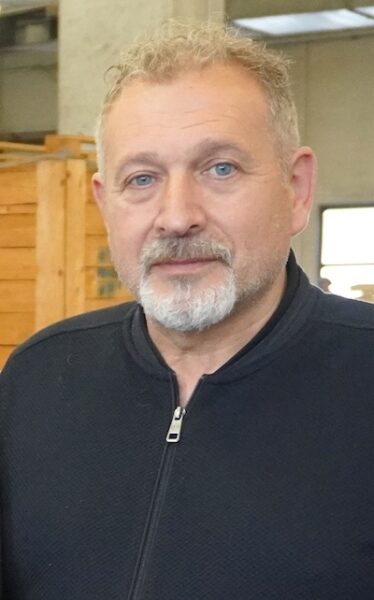
It was a real pleasure to have a long conversation with Fabio Benvenuti, founder of Wood Box, a social cooperative that manufactures special packaging and recovers waste from the optimisation process thanks to a line supplied by Paoletti Engineering.
Let us clear up any possible misunderstanding straight away: Wood Box, based in Nervesa della Battaglia in the province of Treviso, is a company in every respect. There should really be no need to point this out, but when talking about a social cooperative, or businesses with a strong ethical dimension, such distinctions sadly still seem necessary.
“I did not start out as an entrepreneur: I have always worked in environments where leadership, rather than ownership, shapes governance. This belief led me, many years ago now, to establish my first social workers’ cooperative, a corporate structure that I feel is very close to what I think, to who I am and to my own story”.
Fabio Benvenuti, founder and driving force behind Wood Box, immediately makes the boundaries of the story clear: “Wood Box is an economic organisation that expresses important values from every point of view: a real company that is not there to serve other businesses only when it suits them, as often happens with social enterprises, but one that brings its own expertise, professionalism and vision to the table without any form of subordination, on an equal footing…
We have worked hard to make those customers who thought they could find a low-cost supplier in us understand that our quality was exactly the same as that of any other company and that, therefore, we expected to be paid fairly, because even a social enterprise survives if it makes a profit, if it is useful!”.
Today Wood Box specialises in the production of special, fully customised wooden packaging. This position was also reached thanks to relationships with major groups and companies which, sharing an ethical vision of business, proved to be valuable partners along the way: “… they helped us grow and identify the packaging sector as a very real opportunity, to the point where it became our world”, Benvenuti explains.
Today the company operates from two sites, with 8,000 square metres of production space and 24 employees.
“We have grown considerably since 2004, the year we were founded. We have introduced materials and equipment that have made us more efficient and enabled us to produce more. This willingness to invest has continued over the years, in the knowledge that our strength has always been, and will continue to be, flexibility and the ability to respond immediately, just in time!”, Fabio Benvenuti continues. “Little by little, we realised that we could be more than just suppliers to a number of companies and could establish ourselves independently on the market. We developed industrial packaging methods that could even be integrated ‘in line’ into our customers’ production flows, turning ‘transport protection’ into an actual stage in the production process of our partners, because by that point there was no other way to describe them.
It has been an important growth path which, as I mentioned, was made possible by the openness and vision of certain customers who welcomed us in and with whom we built significant relationships. These helped us establish our own identity while enabling them to rely on us to become more productive and efficient”.
Are you satisfied with the decision to enter the packaging sector?
“All things considered, we made a good choice”, Benvenuti confirms after a few seconds’ reflection. “It is a business in which people are still important, where a great deal depends on their skills, availability and expertise. Every day we face something new that allows us to express all our passion.
Packaging is a simple world, if you allow me to describe it that way, although there is no shortage of very complex requirements. High-quality equipment allows us to deal with these with greater confidence and, as in the case of our latest investment, to operate in a more sustainable way”.
What do you mean?
“… a few years ago I became tired of seeing huge containers of offcuts ending up in landfill. We tried to turn them into raw material for other companies working with small pieces, but it did not work. We committed ourselves to organising our work and our habits even better so that we could use less and less wood, and I have to say that the results came: we managed to reduce waste from 300 tonnes a year to 108.
But we knew there was more we could do, and the right idea came from another of my priorities, namely attention to recycling, recovery and the circular economy. These concepts made me think that perhaps we could join pieces of wood back together to recreate the boards we needed for our work.
The technologies already existed: the challenge was to adapt them to the quality of the wood we use, our procedures and our objectives. We began talking to companies that manufacture this kind of equipment and met Pierluigi Paoletti of Paoletti Engineering, a company that, alongside unquestionable technical expertise, also reflects a human dimension and values that we share”.
What exactly are we talking about?
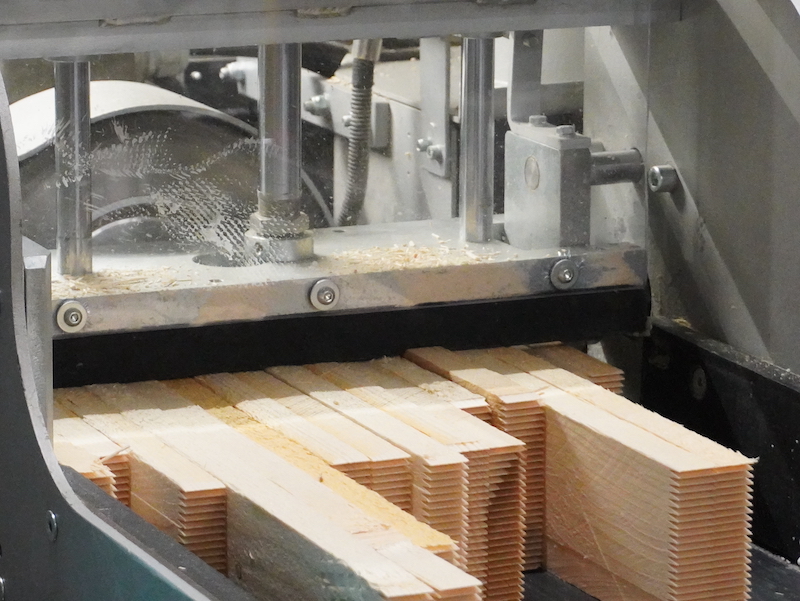
“I am talking about our decision to invest in a ‘finger joint’ line, a well-established technology that certainly needs no introduction, which we believed could be adapted to our specific needs. We worked on the idea for a long time with Paoletti and ultimately developed a line in which small wooden pieces, with a minimum length of around twenty centimetres, are loaded, their ends milled, adhesive applied to one side and then, thanks to a longitudinal press, joined together again to create a beam that we subsequently cut to six metres, the ideal length for our work.
It may sound like a very simple solution, but given the material we use, defining the best possible solution capable of guaranteeing effectiveness and efficiency was no small task”.
You seem to have won quite a challenge…
“… I would say that we have taken another step towards demonstrating that an ethical and inclusive company is not a ‘charitable operation’, but a place where people design, manufacture and give substance to an entrepreneurial vision, even if that vision is based on values that are essential to us. In my opinion, our economic and production culture should demonstrate a greater ability to involve people: 30 per cent of the people working at Wood Box have some kind of ‘difficulty’; the secret of a social cooperative, of an economic organisation that pays attention to people with ‘different’ abilities, is knowing how to find the right place for everyone, with the right motivation.
We work with people with disabilities, psychiatric conditions or learning difficulties. The ethical aspect is a priority, but let me say that first and foremost this is a group of people I care deeply about, people who have always been with me and will continue to be with me”.
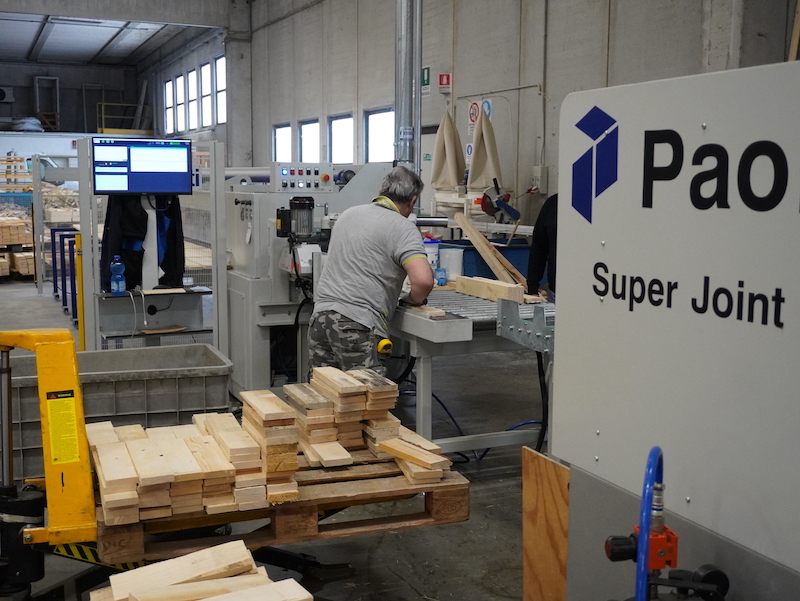
“Bringing one of our technologies into a context with these values gave us a very special sense of satisfaction”, says Pierluigi Paoletti, owner of Paoletti Engineering, which supplied the new finger joint line. “There was a challenge to overcome, and it was stimulating to put our expertise at the service of a system capable of enabling Wood Box to seize new opportunities.
After all, we are talking about an ethical technology that promotes recovery, sustainability and environmental compatibility. A line whose purpose is to ‘rebuild’ a raw material expresses equally important values, in my view, and can play a role in the broader challenge of the circular economy, avoiding recycling, which is extremely energy intensive, in favour of rebuilding…
The process itself is very simple, although it incorporates several solutions that have made this line particularly high-performing. I am thinking of the energy-recovery motors, for example, as well as the sensors that allow the system to operate at full capacity only when required, resulting in significant energy savings. We technology manufacturers serving the woodworking industry must always remember that we work with a material whose value goes far beyond the purely economic aspect”.
“I completely agree”, Fabio Benvenuti concludes. “As we have said several times, all of this stems from the desire to ‘recondition’ our waste: through a virtuous process we ‘regenerate’ waste which, let us not forget, is literally ‘zero-kilometre’, because it is generated just ten metres away, and turn it into what for us is a perfect raw material!
What is more, in our system we also use FitOK-certified wood. We have therefore proposed working together with the certification bodies to define a specific procedure that would allow the material to retain its compliance even after finger jointing, supported by a dedicated traceability process. And one day, if everything develops in the right direction, our plant could not only supply our own reconditioned raw material, but become a certified ‘regeneration’ centre for anyone interested in adopting our approach”.
by Luca Rossetti
Read also...
Hymmen at Tech-Together 2026: surfaces, digital printing and data in focus
Italy-Austria, the timber sector looks to a shared roadmap
Homag Treff 2026: technologies, automation and digitalisation in the spotlight

FederlegnoArredo: new presidents elected for the furniture associations

The state of “Made in Italy”