Ima Schelling: “The old recipes no longer work”
Maximilian Lehner, CEO of IMA Schelling, talks about the Italian market, the logic behind the Sirio and Carmet acquisitions, and how end-to-end process thinking is shaping the next competitive advantage.
How is the trend for orders and turnover at IMA Schelling, with particular reference to the Italian market?
“The broader market environment remains challenging, with no signs of a short-term recovery yet. That is the reality – not just for us but for the entire woodworking industry. Right now, customers are more selective and the pressure to justify every euro spent is higher than it was two years ago. In that environment, companies that still invest are those with a clear strategic plan. And those are exactly the customers we want to work with.
Italy has always been one of our key markets. When you look at what we have built with some of our customers over the past years through consecutive investment phases, it becomes clear that these are not just supplier relationships but true partnerships built on trust and time”.
Is there a particular focus on “Made in Italy” customers?
“Italian furniture manufacturers, particularly in the kitchen and bathroom segments, are among the most demanding customers globally. They combine high-volume output with exceptional product complexity and quality standards, along with a high degree of customization. This combination requires you to think differently as a manufacturer.
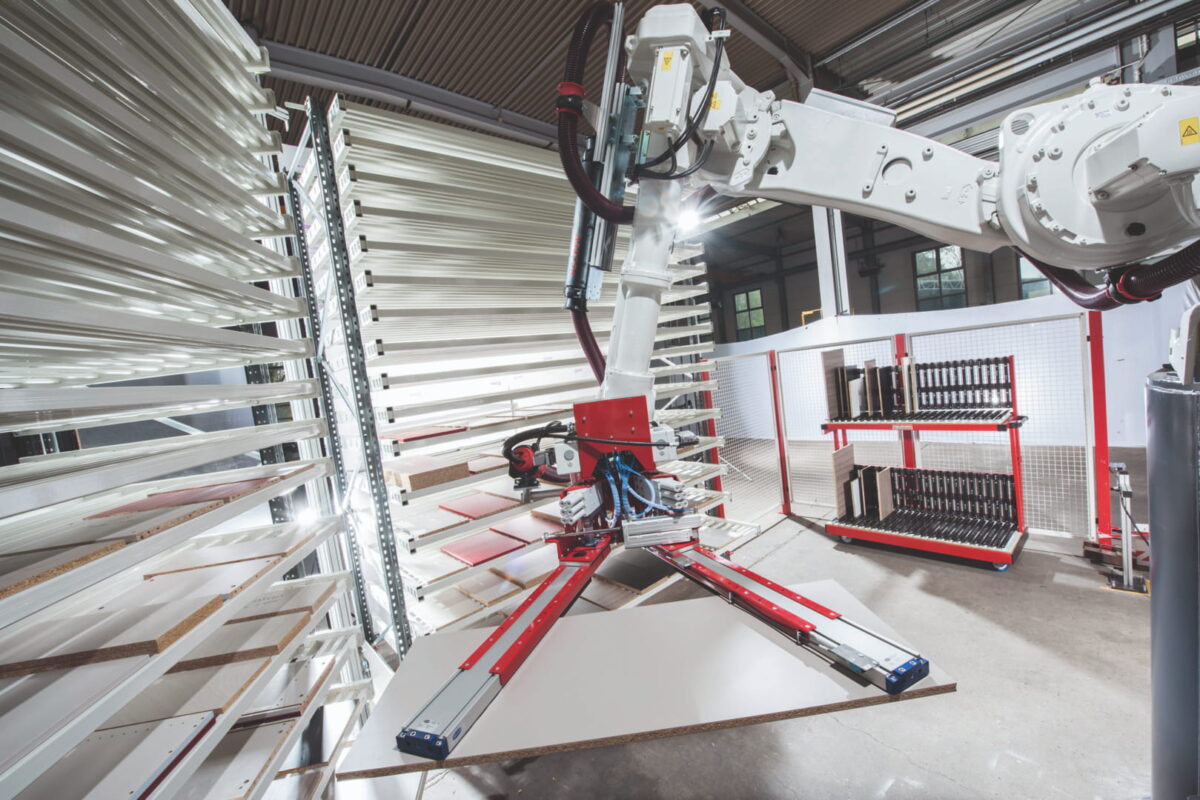
Our newly created “Smart Feedback” system is a perfect example. It is a standardized return-and-stacking solution for “Novimat” edgebanders, developed in collaboration with our recent acquisition Carmet Automazioni. It only exists because Italian customers pushed us toward complete system solutions at competitive price points”.
The Italian market is undoubtedly challenging: what more or different can IMA Schelling offer to be more attractive to Italian customers?
“We shifted our focus from just selling machines to selling production outcomes. Italian manufacturers today don’t buy a saw, they buy 250 kitchens per day with high production flexibility and maximum machine uptime. This approach changes the way you design systems and support customers. What we offer that most competitors cannot is true end-to-end process ownership for tailor-made customer solutions and our ability to handle the entire technology chain – from panel storage to cutting, edgebanding, drilling, transportation, and end-of-line – as an integrated ecosystem with our own brands.
But the real differentiator is software and smart automation. Carmet and Sirio bring exceptional automation and line-control expertise, giving us a clear advantage in complex production environments. In combination with “aimi”, our standardized machine control across the entire IMA Schelling portfolio, every machine soon speaks the same language. This results in consistent data flows that no longer require translation layers between individual machines. Our experience platform “Zimba” turns that data into something a plant manager can actually work with. For customers running multiple production lines across multiple sites, this setup is worth more than a faster saw speed”.
What strategy has guided you in the Italian market, and what were the reasons behind the acquisitions of Sirio and Carmet?
“Both Sirio and Carmet already had long-standing relationships with IMA Schelling, which is exactly why both acquisitions made sense to us. We understood their capabilities, and they knew about our strategy. By integrating both companies into our group, we have added their automation expertise to our portfolio. We will ensure that the entrepreneurial spirit of both companies is maintained, allowing fast decisions and a close connection with customers. Together with our existing service organization, we have now established a very strong presence in the Italian market. The results are already evident in new products. Smart Feedback would not exist without Carmet’s automation expertise”.
Looking back: what advantages did the merger between IMA and Schelling bring? What new scenarios opened up?
“Before the merger 11 years ago, both companies were already very strong in their respective domains. Schelling held a market-leading position in panel sizing and precision-cutting systems. IMA had leading technology in edgebanding, drilling, and downstream processing.
The merger created something neither could build alone: a credible single-source partner for the complete processing line. Customers who previously had to evaluate and manage relationships with multiple suppliers could now work with a single engineering partner. That simplification creates real economic value – in project management, integration quality, and long-term service.
It also created scale for R&D that neither company could have independently. Developing a new machine control platform or a digital service infrastructure requires sustained investments, which is easier to achieve at our combined size”.
What did this mean in terms of the technological offering?
“The most visible change was portfolio completeness. We can now plan and engineer a line from the very first cut to the finished sorted stack – with hardware concepts that share a mutual philosophy, a standardized software layer and service teams that understand the complete process chain.
Probably even more important: it changed our approach to engineering. When you control the entire process, you stop optimizing individual machines and start optimizing output and uptime across the entire system, which leads to better solutions for your customers. The batch one lines we recently built for a leading Italian bathroom furniture manufacturer wouldn’t have been possible at that level of integration without our combined portfolio”.
We are undoubtedly in a “mature” phase for woodworking technology. Where are the real opportunities to say something new?
“The machine hardware is mature, but that is not where the next competitive advantage is built. It is built in three areas: software that runs the entire system, the data these systems generate, and a service model that optimizes uptime across the entire production lifecycle.
A company that builds the best capabilities to turn production data into actionable insights will have an advantage that cannot be replicated by simply lowering machine prices. Batch size 1 at scale is another interesting segment. The industry already solved it on a small scale years ago. Solving it at 90,000 units per year, with full flexibility and competitive unit costs, remains an engineering challenge for most manufacturers. But that’s exactly where we are positioning ourselves on the market”.
Do you have plans for further openings towards other companies?
“I don’t like to talk about ongoing processes, but let’s put it this way: our acquisition strategy isn’t about size, but about closing capability gaps. Sirio and Carmet addressed specific gaps in our ability to deliver a complete end-to-end process. Any future moves will follow the same logic while supporting our international expansion plans – always with deep respect for the legacies of those companies”.
Read also...
Raute, EUR 31 million order to expand plywood production in Estonia

Lamello at Sicam with “Cabineo”
Farewell to Luigi Alberti

Holzmesse Klagenfurt 2026: more than 22,000 visitors
Salvamac e Harwi join forces in cross-cutting